
Best Weighted Blankets for Sleep: How to Choose One
For years my bedtime routine was whatever was left after a twelve-hour rotating shift. Lights off, brain still running, body tired but wired. So when weighted blankets went from occupational therapy offices to every big box store, I understood the appeal right away. The pitch is simple: a heavy blanket that feels like a firm, steady hug might help a racing mind settle down enough to sleep.
The brutal truth is that a weighted blanket isn’t magic, and the wrong one (too heavy, too hot, too stiff) can make your nights worse. But the research on adults has gotten more interesting than I expected, and picking a good one mostly comes down to four decisions: weight, size, fill and fabric. This guide walks through what the studies actually show, how to choose the best weighted blanket for your body and your bedroom, who should skip them, and a handful of picks based on published specs and reviews.
Affiliate disclosure: some links in this post are Amazon affiliate links. If you buy through them, Deep Sleep Mastery may earn a small commission at no extra cost to you. I haven’t personally tested the blankets below; the picks are based on published specs, materials and professional and owner reviews.
Do Weighted Blankets Actually Help You Sleep?
The idea behind weighted blankets is often called deep pressure stimulation: firm, evenly spread pressure across the body that many people find calming. The Sleep Foundation describes it as a “hug”-like pressure that may help you relax as you fall asleep. That’s the theory. Here’s what the better evidence says.
The insomnia trial everyone cites
The best-known study is a 2020 randomized controlled trial from Sweden’s Karolinska Institutet, published in the Journal of Clinical Sleep Medicine (Ekholm, Spulber and Adler). Researchers gave 120 adults with insomnia and a psychiatric condition (depression, bipolar disorder, generalized anxiety disorder or ADHD) either a heavy metal-chain blanket (8 kg, about 17.6 lb, or 6 kg for people who found 8 kg too heavy) or a light plastic-chain control blanket of about 1.5 kg for four weeks.
The results were striking:
- 59.4% of the weighted-blanket group cut their insomnia severity score by half or more, compared with 5.4% of the control group.
- 42.2% of the weighted group reached remission (a score low enough to count as no clinical insomnia), versus 3.6% of controls.
- In a 12-month open follow-up, people who switched to the weighted blanket saw similar improvements, and no serious side effects were reported. One person dropped out of the first phase because of anxiety.
That’s a real signal, but keep it in perspective. Everyone in the study had a psychiatric diagnosis, one of the raters knew which blanket people had, sleep was measured with wrist actigraphy rather than a lab sleep study, and most participants were women. It shows weighted blankets can help some people with insomnia. It doesn’t prove they’ll fix yours.
What the wider research says
A 2024 scoping review in the American Journal of Occupational Therapy, led by Flinders University occupational therapist Suzanne Dawson, pulled together 18 studies of overnight weighted-blanket use (summary here). The authors found the adult evidence encouraging, with users also reporting better mood and pain management and less sleep-medication use, and concluded overnight use can be recommended for adults. The evidence in children was mixed. They also noted there are still no standard recommendations for blanket weight, type or how long to use one.
And the honest clinical view is “it depends.” Dr. Philip Alapat, a sleep medicine physician at Baylor College of Medicine, put it plainly in a 2026 Baylor interview: some people get real benefit, others notice no difference, and some find them uncomfortable. That matches what I’d expect. A blanket can make winding down easier. It can’t fix a schedule that’s fighting your body clock, untreated sleep apnea, or chronic insomnia that needs proper treatment.
If you’re stuck in a long-term cycle of bad nights, a weighted blanket can be one piece of the puzzle alongside the habits in my natural insomnia remedies guide. But insomnia that lasts three or more nights a week for months is worth taking to a doctor. CBT-I (cognitive behavioral therapy for insomnia) is the first-line treatment, and a blanket isn’t a substitute for it.
How Heavy Should a Weighted Blanket Be?
This is where most people get it wrong. Heavier is not better.
The common starting point is the “10% rule”: choose a blanket that weighs roughly 10% of your body weight. The Sleep Foundation notes there’s flexibility built into that rule; a 15-pound blanket might suit someone who weighs 150 pounds, but could also work across a range of roughly 120 to 180 pounds. Dr. Alapat suggests treating 10% as a rough starting point, adjusting by how you respond, and avoiding blankets over 25 pounds, which he says will be too heavy for most people.
| Your body weight | 10% starting point | Common blanket sizes to consider |
|---|---|---|
| 120 lb | 12 lb | 10–12 lb |
| 150 lb | 15 lb | 15 lb |
| 180 lb | 18 lb | 15–20 lb |
| 200 lb | 20 lb | 20 lb |
| 250 lb | 25 lb | 20–25 lb (most people stop at 25) |
A few practical tips on weight:
- Between two sizes? Most people do better going lighter, especially for a first blanket. You can always add a regular quilt on top; you can’t make a heavy blanket lighter.
- You have to be able to move it. The single most consistent safety rule from experts is that you should be able to push the blanket off easily on your own. If you struggle to lift or turn under it, it’s too heavy.
- Expect an adjustment period. Some people feel restricted the first few nights. Starting with naps or an hour on the couch can help you figure out whether you like the feeling before committing to full nights.
Size: Bed Size vs Body Size
Here’s something that surprises a lot of shoppers: a weighted blanket isn’t supposed to hang over the sides of the bed like a duvet. The weight is meant to rest on you, not on the floor. If a blanket drapes over the edges, the overhanging part pulls the whole thing sideways through the night and you lose the even pressure you paid for.
Most brands sell weighted blankets in sizes that roughly match the top of the mattress (or your body, for a throw) rather than full duvet sizes. A couple of rules of thumb:
- Sleeping solo: pick a size that covers you from shoulders to feet with a little room on each side.
- Sharing a bed: one big blanket at “10% of each person’s weight” rarely works for two people of different sizes. Two separate blankets, each matched to its sleeper, are usually the better call. That also ends the nightly fight over the covers.
Fill Types: Glass Beads, Plastic Pellets or Knit
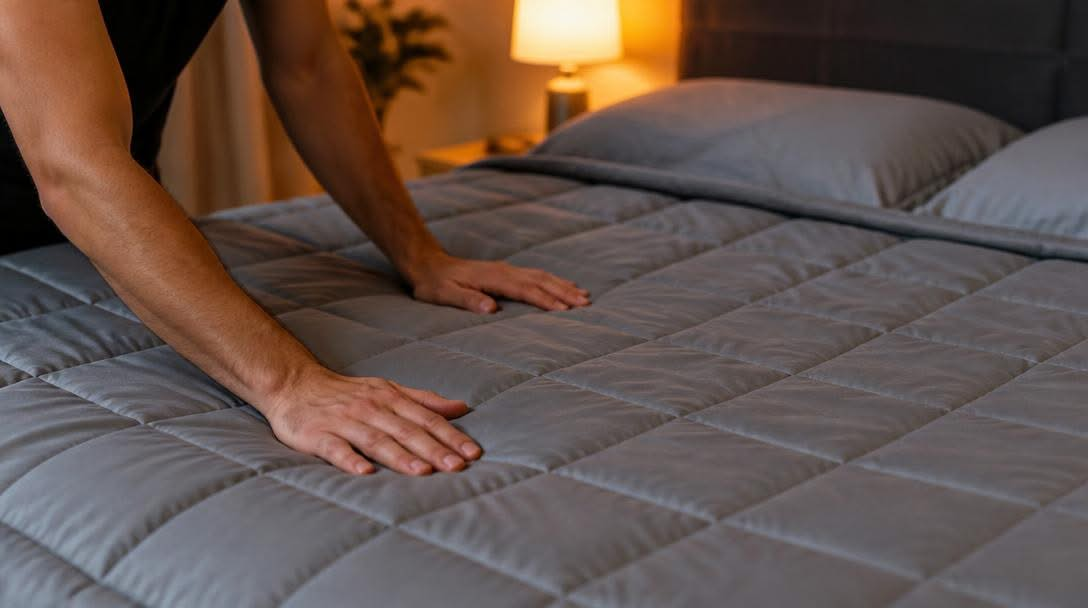
What’s inside the blanket changes how it feels, how hot it sleeps, how noisy it is and how easy it is to clean. Traditional weighted blankets use an insert divided into small stitched squares or channels, each filled with beads or pellets so the weight stays spread out. Some add a layer of batting to soften the feel and muffle the sound of shifting fill.
| Fill / build | Feel | Watch out for |
|---|---|---|
| Glass beads | Small and dense, so a thinner blanket for the weight; drapes well | Can still sleep warm under a plush cover |
| Plastic pellets | Bulkier for the same weight; often cheaper | Thicker blanket, can be noisier as pellets shift |
| Open knit (no beads) | Weight comes from thick knitted fabric; breathes well | Usually pricier; whole blanket must be washed |
Two things to watch for on any bead or pellet blanket:
- Small pockets matter. Smaller stitched squares keep the fill from sliding to one side or pooling at your feet. Big, loose channels are a sign of a cheaper build.
- Leaks happen. Read owner reviews specifically for complaints about beads escaping through seams after washing. It’s one of the most common long-term problems.
Hot Sleeper? Fabric Matters More Than You Think
The number one complaint about weighted blankets is heat. Several extra pounds of dense material in a plush minky cover is cosy in January and miserable by May.
If you tend to sleep hot, look at:
- Open-knit blankets. The Sleep Foundation suggests open-knit designs for people in hot or humid climates because air moves through the gaps.
- Cotton, bamboo-derived rayon or Tencel (lyocell) covers rather than polyester minky or fleece. These natural or semi-natural fibers tend to breathe better and, per the Sleep Foundation, hold up better than polyester or microfiber.
- Reversible covers. Some blankets have a plush side for winter and a smooth cotton side for warmer months.
And don’t forget the rest of your sleep setup. Your room temperature probably matters more than the blanket. I’ve written about why a cooler bedroom tends to help in do you sleep better in the cold. If your mattress traps heat too, my memory foam mattress topper guide covers which toppers sleep cooler.
Washing and Care
A 15- or 20-pound blanket can overwhelm a standard home washer. According to the Sleep Foundation, traditional blankets usually have a removable, machine-washable cover, but the insert itself may need a commercial-size machine (a laundromat) or spot cleaning. Open-knit blankets have no cover, so you’re washing the whole thing every time.
Before you buy, check:
- Whether the cover is removable and machine washable
- Whether the inner blanket can go in a washer and dryer at all, and at what weight limit
- How the cover attaches (ties or loops in the corners and along the sides keep the insert from bunching inside)
Always follow the manufacturer’s care label. Washing a heavy blanket wrong is a fast way to burst seams or damage your machine.
Who Should Skip a Weighted Blanket (or Ask a Doctor First)
Weighted blankets are generally low-risk for healthy adults, but not for everyone. Based on the Sleep Foundation’s guidance and Dr. Alapat’s comments:
- Infants and young children: Dr. Alapat says to definitely avoid them for children under 3 because of suffocation risk, with close monitoring for kids aged 3 to 5. This site is about adult sleep, so if you’re shopping for a child, talk to your pediatrician first.
- Anyone who can’t easily remove the blanket on their own, including some older adults and people with limited mobility or strength.
- Sleep apnea or other breathing problems during sleep: the Sleep Foundation advises talking to a doctor first. If you snore loudly, gasp at night or wake up exhausted, get checked; my guide to what sleep apnea is explains the warning signs.
- Circulation, blood pressure or other chronic health conditions: the Sleep Foundation lists circulatory issues, low blood pressure and type 2 diabetes among the reasons to get a physician’s okay first. The same goes for asthma and other respiratory conditions.
- Claustrophobia or feeling trapped under weight: some people find the pressure stressful instead of calming. That’s useful information, not a failure. Weighted socks or a lighter throw over your legs are gentler options to try.
Top Weighted Blanket Picks Based on Specs and Reviews

I haven’t tested these myself. These picks come from published specs, professional roundups (including HGTV’s tested weighted-blanket review, updated September 2026) and the overall pattern of owner reviews. Prices move constantly, so check current listings.
| Blanket | Build | Best for | Care |
|---|---|---|---|
| Baloo Living Cotton | Glass beads, cotton shell | All-round, warm sleepers | Machine wash and dry |
| Bearaby Tree Napper | Chunky organic cotton knit, no beads | Hot sleepers, quiet | Wash whole blanket |
| Gravity Blanket | Weighted insert, removable cover | Even weight, plush feel | Cover machine washable; insert hand wash |
| Layla Weighted | Glass beads, reversible cover | Year-round use | Whole blanket machine washable |
| Luna Cotton | Glass beads, cotton shell | Budget, first-time buyers | Covers sold separately |
Baloo Living Cotton Weighted Blanket
A glass-bead blanket with a breathable cotton shell that looks more like a quilt than a heavy duvet. Reviewers like that it’s machine washable and dryer safe and comes in a wider range of sizes and weights than many competitors. It’s a good all-round choice if you want one blanket for most of the year. Baloo Living Cotton Weighted Blanket
Bearaby Tree Napper
Bearaby’s Napper line skips beads entirely. The weight comes from thick, tightly knitted fabric, which lets air through and makes it a favorite for hot sleepers. It’s quiet (nothing to shift around) and needs no cover. The trade-offs are price, since it’s usually the priciest option in roundups, and that you wash the whole blanket rather than a cover. Bearaby Tree Napper Weighted Blanket
Gravity Weighted Blanket
One of the brands that made weighted blankets mainstream. Reviewers praise how evenly the weight is spread and how quiet it is, and the removable cover is machine washable, with a cooling cover option available. The downsides: the inner blanket is hand-wash only, and wrestling the cover on and off is tedious. Gravity Weighted Blanket
Layla Weighted Blanket
A glass-bead blanket stitched in a hexagon pattern with a reversible cover: soft, plush polyester on one side and cotton on the other, so you can flip it with the seasons. The whole blanket is machine washable. The main complaint is limited color choice. Layla Weighted Blanket
Luna Cotton Weighted Blanket
The budget pick. Luna uses glass beads in a cotton shell and comes in a wide range of sizes, weights and colors for a fraction of the premium brands’ price. Covers are sold separately. If you’re not sure you’ll like a weighted blanket at all, this is a sensible, low-cost way to find out. Luna Cotton Weighted Blanket
How to Get the Most Out of a Weighted Blanket
Shift work taught me that no single product rescues bad sleep. What helps is stacking small things that tell your body it’s time to shut down. A weighted blanket fits best as part of that routine:
- Use it as a wind-down cue. Pull it on when you start reading or relaxing in bed, not only after lights out. The association helps.
- Keep the room cool and dark. A heavy blanket in a warm room is a recipe for kicking it off at 2 AM.
- Give it two weeks. The Karolinska trial measured results after four weeks. One night isn’t a fair test.
- Get your pillow right too. If you sleep on your side, a weighted blanket won’t fix shoulder or neck pain from the wrong pillow. My side sleeper pillow guide covers that.
If you want a simple way to check the rest of your sleep habits, grab my Free Sleep Checklist. It’s the list I wish I’d had back when I was trying to sleep at 9 AM with the sun blazing through the curtains.
Frequently Asked Questions
What weight should my weighted blanket be?
Start at roughly 10% of your body weight, then adjust by feel. If you’re between sizes, go lighter. Most people shouldn’t go above about 25 pounds, and you should always be able to push the blanket off easily.
Can you sleep with a weighted blanket every night?
For most healthy adults, yes. The 2024 scoping review concluded overnight use can be recommended for adults. If you have sleep apnea, breathing problems, circulation issues or another chronic condition, check with your doctor first.
Are weighted blankets good for anxiety?
Many people find the pressure calming, and the 2020 Karolinska trial included adults with anxiety and other psychiatric conditions who slept better with one. But a blanket is a comfort tool, not a treatment. Ongoing anxiety deserves a conversation with a doctor or mental health professional.
Do weighted blankets make you hot?
They can. If you sleep hot, choose an open-knit blanket or one with a cotton, bamboo-rayon or Tencel cover instead of plush polyester, and keep your bedroom cool.
Can couples share one weighted blanket?
Usually not well. A blanket sized for one person’s weight will feel wrong to a partner of a different size, so two separate blankets tend to work better.
Sources
- Ekholm B, Spulber S, Adler M. A randomized controlled study of weighted chain blankets for insomnia in psychiatric disorders. Journal of Clinical Sleep Medicine, 2020.
- Sleep Foundation. Weighted Blankets: How They Work and How to Choose One.
- Baylor College of Medicine, Momentum. Weighted blankets: the best weight on your shoulders, 2026.
- Dawson S, et al. Weighted blankets as a sleep intervention: a scoping review. American Journal of Occupational Therapy, 2024 (Scimex summary).


