

Memory Foam Mattress Toppers: How to Choose the Right One
A memory foam mattress topper is the cheapest way I know to change how a bed feels without buying a new mattress. Put two or three inches of the right foam on a mattress that’s too firm, and the pressure on your hips and shoulders can ease off noticeably. Put the wrong foam on a mattress that’s sagging, and you’ve just paid to sink into a softer hole.
During my years on rotating shifts I slept on more bad mattresses than I care to count. A topper fixed some of them and did nothing for others. The difference came down to a few things nobody explains on the product page: thickness, density, firmness, heat, and what the mattress underneath is actually doing.
This guide walks through what to look for, who a topper helps (and who it won’t), and then gives a handful of picks based on published specs and the overall pattern of owner reviews.
Affiliate disclosure: some links in this post are Amazon affiliate links. If you buy through them, Deep Sleep Mastery may earn a small commission at no extra cost to you. I haven’t personally tested the toppers below; the picks are based on published specs, materials and owner reviews.
What a Memory Foam Mattress Topper Can (and Can’t) Fix
A topper is a removable layer, usually 1 to 4 inches thick, that sits on top of your mattress under the fitted sheet. Memory foam toppers are made of viscoelastic polyurethane foam, the same slow-sinking material Tempur-Pedic made famous. It softens under body heat and pressure, so it moulds around your shoulders and hips instead of pushing back against them.
That makes a memory foam topper good at a few specific jobs:
- Softening a mattress that’s too firm. This is the classic use. If you wake up with sore hips or a numb arm on a hard bed, a topper adds the cushioning the mattress lacks.
- Adding pressure relief for side sleepers. Side sleeping concentrates your weight on a narrow strip of shoulder and hip. Foam that contours spreads that load out.
- Cutting motion transfer. Memory foam absorbs movement, so a restless partner or a partner on a different shift is less likely to wake you.
- Buying time. A decent topper can make a structurally sound but uncomfortable mattress livable for longer.
And here’s what it can’t do. A topper will not fix a mattress with a real sag or a broken support core. Soft foam follows the shape of whatever is underneath it, so if the mattress has a dip, the topper will have a dip too. If you can see a body impression in your mattress with the sheets off, or you roll toward the middle every night, put the topper money toward a new mattress instead.
How Thick Should a Memory Foam Topper Be?
Thickness decides how much the topper changes the feel of your bed. The Sleep Foundation’s memory foam topper guide notes that most toppers are at least 1 inch thick, but that those measuring 2 to 3 inches are more effective at changing how a mattress feels.
| Thickness | What it does | Best for |
|---|---|---|
| 1–1.5 inches | Light softening, keeps most of the mattress feel | Back sleepers, mattresses that are only slightly firm |
| 2 inches | Noticeable contouring without much sink | Most combination and back sleepers |
| 3 inches | Deep pressure relief, clearly changes the bed’s feel | Side sleepers, very firm mattresses |
| 4 inches | Almost a new comfort layer; more sink and more heat | Heavier side sleepers on a very hard bed |
Two practical notes. First, a thick topper makes the bed taller, which can make getting in and out harder and may leave your fitted sheets too shallow. Measure your mattress plus topper before you buy sheets. Second, thicker isn’t automatically better. Too much soft foam can let your hips sink below your shoulders, which is the opposite of what a sore back needs.
Density, Firmness and Why They’re Not the Same Thing
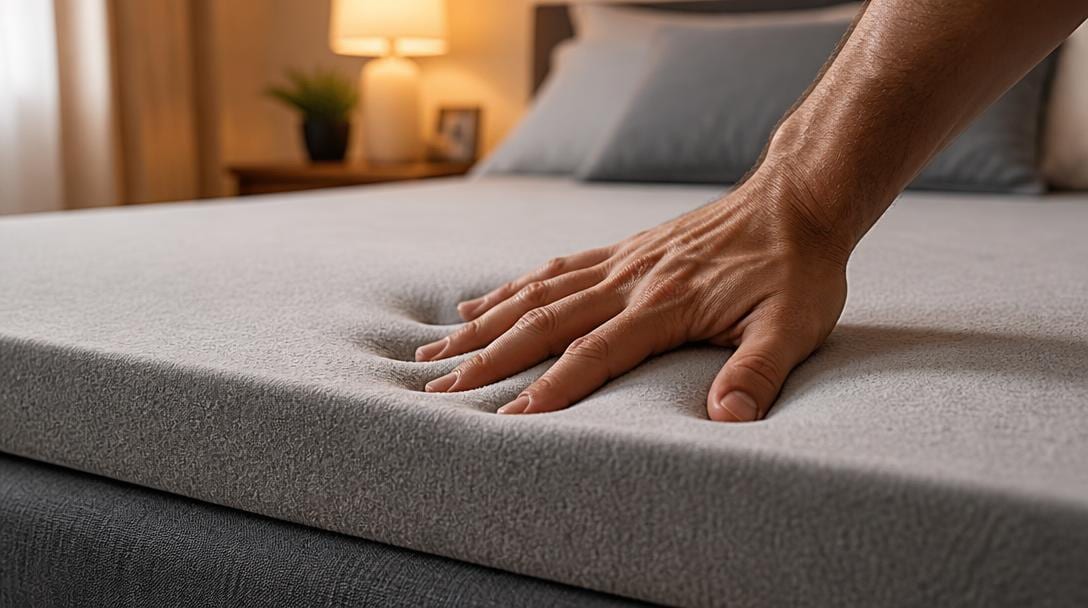
Density: how much foam is packed in
Density is measured in pounds per cubic foot (lb/ft³). It tells you how much material is in the foam, which mostly affects durability and that slow, hug-like memory foam feel. As a rough rule of thumb used across the bedding industry, memory foam under about 3 lb/ft³ is treated as low density, around 4 lb/ft³ as medium, and 5 lb/ft³ and up as high density.
The Sleep Foundation notes that denser foam tends to be more durable and isolates motion more consistently, while less dense foam is usually more breathable and gives off less of that new-foam smell. So there’s a trade-off: high density lasts longer and feels more “memory foam,” lower density sleeps a bit cooler and cheaper but can develop body impressions sooner.
Firmness: how it feels when you lie on it
Firmness is how soft or hard the topper feels. Brands usually describe it as soft, medium or firm, or on a 1–10 scale. Most memory foam toppers sit in the soft-to-medium range, because their main job is softening a firm bed. A high-density topper can still feel soft, and a low-density one can feel firm, so check both specs.
If you have back pain, don’t automatically go as soft as possible. A well-known randomised trial of 313 people with chronic low back pain, published in The Lancet in 2003 by Kovacs and colleagues, found that a medium-firm mattress improved pain and disability more than a firm one. A later 2021 review of 39 studies in the Journal of Orthopaedics and Traumatology reached a similar conclusion: medium-firm surfaces promoted comfort, sleep quality and spinal alignment. Neither study tested toppers specifically, but the takeaway carries over. Aim to turn a too-firm bed into a medium-firm one, not a marshmallow.
Match the Topper to How You Sleep
Your sleep position and body weight matter more than any marketing claim.
- Side sleepers: usually do best with 3 inches of soft-to-medium foam, so the shoulder and hip can sink in enough to keep the spine straight. Pair it with a pillow that fills the gap between your ear and the mattress; my guide to the best pillows for side sleepers covers how to get that height right.
- Back sleepers: 2 inches of medium foam is often enough. You want support under the lower back, not a hammock.
- Stomach sleepers: be careful. Too much soft foam lets the hips sink and arches the lower back. If you add a topper, keep it thin (1–2 inches) and on the firmer side.
- Combination sleepers: 2 inches is a sensible middle. Very slow-responding foam can feel like wading through mud when you change positions, so a gel or open-cell foam with a quicker bounce-back is worth considering.
- Heavier sleepers (roughly 230 lb and up): look for high-density foam at 3 to 4 inches. Low-density foam bottoms out faster under more weight.
- Lighter sleepers (under about 130 lb): may not sink far into dense foam at all, so a softer topper usually feels better.
Memory Foam and Heat: The Big Complaint
Ask anyone who’s returned a memory foam topper why, and “it sleeps hot” comes up a lot. Traditional memory foam is dense and hugs your body, which means less air moving around you and more of your own heat held close.
Your core body temperature needs to drop a little for you to fall asleep and stay in deeper sleep. The Sleep Foundation puts the ideal bedroom temperature at around 65°F (18.3°C), and recommends bedding that helps regulate body temperature. I’ve covered the science of this in do you sleep better in the cold?
If you run warm, look for:
- Open-cell foam, which has a more porous structure that lets air move through it.
- Gel, graphite or copper infusions, which manufacturers add to draw heat away from the surface. Results vary, and none of them make memory foam feel like a cool latex or innerspring bed, but owners of gel-infused toppers generally report less heat build-up than with plain foam.
- A thinner topper. Less foam means less insulation.
- Breathable bedding on top. Cotton percale or linen sheets help. A thick quilted mattress protector over the topper can undo the cooling features.
Safety, Smell and Certifications
New memory foam often has a chemical smell when you first unroll it, called off-gassing. It comes from volatile organic compounds (VOCs) released by the foam. For most people it’s just unpleasant and fades within a few days, but there’s no reason to sleep on more of it than you need to.
The simplest thing to check is the CertiPUR-US label. Certified foams are made without formaldehyde, ozone depleters, mercury, lead and other heavy metals, and phthalates regulated by the U.S. Consumer Product Safety Commission, and they’re tested for low VOC emissions (less than 0.5 parts per million). Most reputable topper brands carry it. If a listing doesn’t mention it, I’d move on.
If you’re sensitive to smells or have a respiratory condition that’s triggered by odours, it’s worth asking your doctor before putting new foam in your bedroom, and choosing a certified topper with a strong return policy.
Our Top Picks Based on Specs and Reviews
These are well-reviewed memory foam toppers that are widely available on Amazon in the US and Canada. Sizes, thickness options and prices change often, so check the listing for the current details before you buy.
| Pick | Best for | Key feature |
|---|---|---|
| ViscoSoft High Density | Best value, heavier sleepers | Gel-infused, medium-firm, 3 or 4 inches |
| Tempur-Pedic TEMPUR-Adapt | Pressure relief, premium | 3-inch TEMPUR material, medium feel |
| LUCID Gel Memory Foam | Budget, choice of thickness | Gel-infused, several thickness options |
Best Value: ViscoSoft High Density Memory Foam Topper
The Sleep Foundation named ViscoSoft’s high-density topper its best-value memory foam pick, and the owner reviews are consistent: it’s dense, supportive and doesn’t bottom out quickly. It comes in 3- and 4-inch versions with gel-infused foam, and its medium-firm feel suits back and stomach sleepers and people over about 130 lb better than very light sleepers. Check the ViscoSoft High Density Memory Foam Topper on Amazon
Best for Pressure Relief: Tempur-Pedic TEMPUR-Adapt Topper
This is the expensive one. It’s a 3-inch layer of Tempur-Pedic’s own foam with a medium feel, and it’s the closest you’ll get to making an ordinary mattress feel like a Tempur bed. The Sleep Foundation lists it as a top pick for pressure relief and suggests it suits side sleepers and back sleepers who like a softer surface. The trade-offs: it’s dense, so it may hold some heat, and it costs several times more than budget options. Check the Tempur-Pedic TEMPUR-Adapt Topper on Amazon
Best Budget Pick: LUCID Gel Memory Foam Topper
LUCID’s gel-infused toppers are some of the most reviewed on Amazon, and they’re popular for a simple reason: you can pick your thickness at a price that won’t sting if it turns out to be the wrong call. Owners generally describe them as soft with a decent amount of contouring for the money. Expect some new-foam smell at first and a shorter lifespan than high-density foam. Check the LUCID Gel Memory Foam Topper on Amazon
Setting Up and Caring for Your Topper

Most toppers arrive rolled and vacuum-packed. A few simple steps make the first week a lot better:
- Unroll it in a ventilated room. Open a window and give it 24 to 72 hours to expand fully and air out before you sleep on it. Follow the manufacturer’s timing if it’s different.
- Check which side is up. Some toppers have a cooling or textured side that’s meant to face you.
- Keep it from sliding. A deep-pocket fitted sheet, or a topper cover with elastic corners, stops it from creeping off the edge overnight.
- Use a protector. Memory foam generally can’t go in the washing machine. A thin, breathable waterproof protector over the topper keeps sweat and spills out of the foam.
- Spot clean only. Use mild soap and water, blot rather than scrub, and let it dry completely before you put the sheets back on.
Give it at least a couple of weeks before you decide. It takes your body a while to adjust to a new sleep surface, and the foam often softens slightly after the first few nights.
Is a Topper Worth It, or Do You Need a New Mattress?
A topper makes sense when your mattress is still supportive but feels too firm, when you’re renting or staying somewhere temporarily, or when you want to test whether a softer feel helps before spending on a new bed. It doesn’t make sense when the mattress is sagging, lumpy or broken down, because the foam will just follow those problems.
And if you’re sleeping badly no matter what you lie on, the bed may not be the real issue. Persistent pain that wakes you, loud snoring with gasping, or daytime exhaustion despite a full night in bed are all worth raising with your doctor rather than fixing with foam. Comfort helps, but it won’t cure an underlying sleep disorder, and getting enough deep sleep depends on more than your mattress.
If you want a quick way to check the rest of your bedroom setup, grab my Free Sleep Checklist. It covers temperature, light, noise and the other basics that matter just as much as what you sleep on.
Frequently Asked Questions
Is a 2-inch or 3-inch memory foam topper better?
It depends on how you sleep and how firm your mattress is. A 2-inch topper adds noticeable contouring and suits most back and combination sleepers. A 3-inch topper gives deeper pressure relief and is usually the better choice for side sleepers or a very firm mattress.
Do memory foam toppers help with back pain?
They can, if your mattress is too firm and the topper brings it closer to medium-firm, which research links to less back pain and better spinal alignment. A topper that’s too soft can make back pain worse by letting your hips sink. If back pain is ongoing or getting worse, see your doctor or a physiotherapist.
How long does a memory foam topper last?
There’s no single answer, because it depends on foam density, body weight and care. Denser foam generally holds its shape longer, while low-density budget toppers tend to develop body impressions sooner. Warranty length is a useful clue to how long the manufacturer expects it to last.
Is the smell from a new memory foam topper harmful?
The smell comes from VOCs released by new foam, and it usually fades within a few days in a ventilated room. Choosing a CertiPUR-US certified topper means the foam has been tested for low VOC emissions. If you’re sensitive to odours or have a respiratory condition, check with your doctor and air the topper out well before using it.
Will a memory foam topper fix a sagging mattress?
No. Memory foam follows the shape of what’s underneath it, so a sag in the mattress shows up in the topper too. If your mattress has visible dips or you roll toward the middle, it’s time to replace the mattress.