
Do You Sleep Better in the Cold? The Science Behind Your Perfect Sleep Temperature
Introduction
Here’s something wild: dropping your bedroom temperature by just 5 degrees can increase your deep sleep by up to 10%. I know, I know – sounds like one of those too-good-to-be-true sleep hacks, right? But after seven years of obsessively tracking my sleep (yeah, I’m that person), I can tell you that temperature might be the single most overlooked factor in getting quality rest.
I used to be the guy cranking up the heat in winter, burying myself under three blankets, and wondering why I’d wake up feeling like I’d been hit by a truck. Everything changed when I accidentally left my window cracked one November night and had the best sleep I’d had in months!
In this article, I’m gonna walk you through exactly why sleeping in a colder room works so well, what temperature actually counts as “cold” for sleep, and how to dial in your perfect sleep temperature without freezing your partner out or demolishing your electric bill.
So, do you sleep better in the cold? This question has intrigued many, and the answer could change the way you approach your nightly routine.
Okay, so here’s the deal with your body and temperature – it’s way more complicated than just feeling hot or cold. Your core body temperature actually needs to drop by about 2-3 degrees Fahrenheit to trigger sleepiness. This isn’t some random thing; it’s built into your circadian rhythm like hardwired programming.
When the sun goes down, your body starts this natural cooling process. Your hands and feet warm up (that’s blood moving to your extremities to release heat), and your core temperature drops. This temperature decline signals to your brain that it’s time to produce melatonin and get ready for sleep. Pretty cool biological system, right?
But here’s where it gets frustrating. If your bedroom is too warm, your body can’t complete this cooling process efficiently. I spent like two years wondering why I’d toss and turn for hours, only to realize my thermostat was sabotaging me the whole time. A room that’s 74°F feels comfortable when you’re awake, but it’s basically kryptonite for your sleep cycle.
The science gets even more interesting when you look at sleep stages. During REM sleep – that’s when you dream and your brain does all its memory consolidation – your body temporarily loses its ability to regulate temperature. If your room is too hot during these periods, you’ll actually wake up or shift into lighter sleep stages. I noticed this pattern in my sleep tracking data before I even knew the science behind it.
And deep sleep? That’s even more temperature-sensitive. Studies have shown that people sleeping in cooler rooms (around 66-67°F) spend significantly more time in deep sleep compared to those in warmer environments. Deep sleep is where all the physical recovery happens – muscle repair, immune system strengthening, all that good stuff.

What “Cold” Actually Means for Sleep (Spoiler: It’s Not Arctic)
Let me clear something up right away – when sleep experts say “cold,” they don’t mean you should be sleeping in an igloo. I learned this the hard way after one particularly enthusiastic experiment where I set my thermostat to 58°F and woke up shivering with a stiff neck. Not fun.
The sweet spot for most people falls between 60-67°F (that’s about 15-19°C for my international readers). But here’s the thing that nobody talks about enough: this is a range, not a magic number. Your perfect temperature might be different from mine, and that’s totally normal.
I’ve found that my ideal temperature is 64°F, but I’ve talked to people who swear by 68°F or others who go as low as 62°F. Factors like your age, metabolism, body composition, what pajamas you wear (or don’t wear), and even your bedding all affect what temperature feels right. Older adults tend to prefer slightly warmer temps, while younger people often sleep better on the cooler end of the spectrum.
There’s also this concept of “too cold” that people don’t think about. If you’re cold enough that you’re tensing your muscles or curling into a tight ball, that’s counterproductive. You want to be cool enough that your body can offload heat, but not so cold that you’re uncomfortable. Think “fresh and crisp” not “shivering and miserable.”
One trick I use is the “hand test” – if I stick my hand out from under the covers and it feels refreshingly cool but not uncomfortable, I know I’m in the right zone. It took me probably three months of adjusting to dial this in perfectly, but once you find it, you’ll know immediately.
The Remote Worker’s Temperature Challenge
Man, working from home absolutely destroyed my sleep temperature game when I first started. Nobody warns you about this! Your bedroom becomes your office, and suddenly you’ve got a laptop, dual monitors, and maybe a desk lamp all pumping heat into what’s supposed to be your sleep sanctuary.
I remember my first summer working remotely – my bedroom-office combo would hit like 78°F by late afternoon, and even with the AC running at night, the room stayed warm for hours. My sleep tracker looked like a disaster zone during that period. Total deep sleep? Maybe 45 minutes on a good night. It was brutal.
The real problem is that electronics continue to radiate heat even after you shut them down. Your laptop doesn’t instantly cool to room temperature – it sits there gently warming your space for hours. And if you’re like me and used to fall asleep immediately after closing your laptop at midnight, you’re trying to sleep in what’s basically a mini sauna.
Here’s what actually worked for me: I started shutting down all my work tech at least two hours before bed. Just turning off the monitors and closing the laptop made a measurable difference. I also moved my main work setup as far from my bed as possible – even in a small space, every foot of separation helps with the heat transfer.
For my fellow remote workers in apartments or small spaces, a window fan became my best friend. Running it for just 30 minutes before bed would flush out all that accumulated heat. In winter, I’d crack the window; in summer, I’d run it in reverse to pull in cooler air. Game changer.
How to Make Your Bedroom Colder Without Freezing Your Wallet
Let’s be real – I’m not about to tell you to crank your whole-house AC to 62°F and watch your electric bill skyrocket. I made that mistake in month one of my temperature experiments, and let’s just say my wallet wasn’t happy. There are way smarter ways to cool your sleep environment.
Smart thermostats are absolutely worth the investment if you don’t have one yet. I use mine to automatically drop the temperature at 9 PM (my usual wind-down time) and then raise it back up at 6 AM. This targeted cooling saves a ton of money compared to running cold temps all day. You can find decent smart thermostats for under $130, and they usually pay for themselves within a year through energy savings.
But the real MVP in my sleep setup? A cooling mattress pad. I resisted buying one for like two years because they seemed expensive and gimmicky. Finally caved and got one, and holy crap – it’s one of the best sleep purchases I’ve ever made. The one I use has a water circulation system, and it keeps my side of the bed at exactly 62°F while my partner’s side stays at her preferred 68°F. Problem solved!
If you’re on a tighter budget, start with your bedding. Cotton sheets trap heat; linen or bamboo sheets actually help with cooling. I switched to linen sheets last spring, and the difference was immediately noticeable. They feel cooler to the touch and wick away moisture better than regular cotton. They were about $80 for a queen set – not cheap but way less than a cooling mattress pad.
Here’s a weird hack that actually works: put your pillowcase in the freezer for 30 minutes before bed. Sounds crazy, I know, but that initial cold sensation can help trigger your body’s cooling response. It’s free, and on really hot nights, it’s surprisingly effective. I’ve also tried the frozen water bottle near the fan trick, and while it’s not a long-term solution, it’ll drop your room temp by a few degrees in a pinch.
When Cold Sleep Goes Wrong (And How to Fix It)
Okay, so I’ve been hyping up cold sleeping, but let’s talk about when it goes wrong – because trust me, it can. There’s a fine line between “refreshingly cool” and “why are my toes numb?”
The biggest sign you’re too cold is waking up with tense muscles, especially in your neck and shoulders. Your body tries to conserve heat by tensing up, which obviously destroys sleep quality. I went through a phase where I was so obsessed with keeping my room cold that I’d wake up with these terrible tension headaches. Had to dial it back by about 3 degrees before I found my balance.
Then there’s the partner temperature war – probably the most common cold-sleep problem. My girlfriend and I had some serious debates about this when we first moved in together. She’d be under three blankets while I was barely covered, and neither of us was sleeping great. The solution? Separate blankets and that cooling mattress pad I mentioned earlier. Seriously, if you’re in a relationship and arguing about temperature, dual-zone bedding is worth every penny.
Seasonal adjustments are trickier than you’d think. What feels perfect in winter might be way too cold in summer when you’re already adapted to warmer temps. I adjust my thermostat by about 2-3 degrees seasonally – warmer in winter (around 66°F), cooler in summer (around 62-63°F). Your body acclimates to the season, so fighting against that is just making life harder.
And cold feet – man, cold feet will absolutely wreck your sleep. Even if your core temperature is perfect, if your extremities are too cold, you won’t be able to fall asleep easily. The solution? Socks. I know some people hate sleeping in socks, but hear me out – warming your feet actually helps your core temperature drop by improving blood flow. It’s counterintuitive but it works!
Tech Solutions for Perfect Sleep Temperature
Let me show you my current sleep tech stack for temperature control, because after years of experimentation, I’ve got this pretty dialed in. This isn’t me trying to sell you stuff – this is genuinely what I use every single night.
First up: the Nest Learning Thermostat. I’ve had it for three years now, and it’s paid for itself multiple times over in energy savings. It automatically figured out my schedule within like two weeks and now starts cooling my bedroom without me even thinking about it. The app lets me adjust things from bed, which is clutch when my temperature preference shifts slightly night to night.
My cooling mattress pad is the ChiliSleep OOLER (I’m not sponsored, just obsessed). It uses actual water circulation to actively cool or heat your side of the bed to whatever temperature you want. The control unit is a bit loud – sounds like a small aquarium pump – but I run white noise anyway so it doesn’t bother me. It’s pricey at around $500-700 depending on size, but for me, it was worth every cent.
For monitoring, I use the Oura Ring to track my sleep stages and see how temperature changes affect my deep and REM sleep. It doesn’t directly measure room temperature, but I can correlate my subjective temperature comfort with objective sleep quality data. This helped me figure out that 64°F was my sweet spot – I could literally see the deep sleep percentage jump when I hit that number.
A BedJet is another option I tested briefly. It’s basically a fan that blows temperature-controlled air under your sheets. Works great for quick cooling, but I found it too noisy for my preferences. That said, I know people who absolutely love it, especially for hot flashes or quick temperature adjustments.
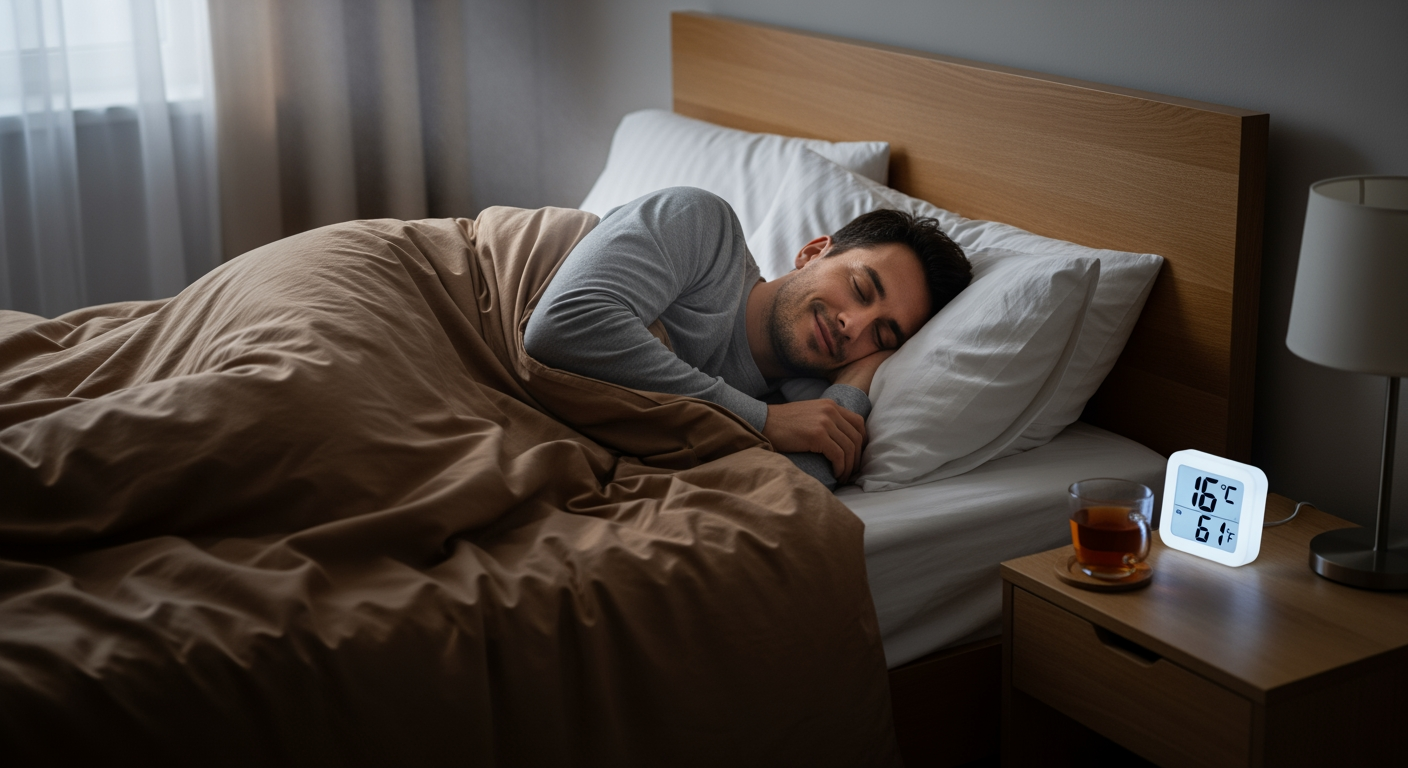
The most underrated piece of tech? A simple room thermometer with humidity monitoring. I keep one on my nightstand, and glancing at it has become part of my wind-down routine. If I see it’s above 67°F, I know I need to adjust something before trying to sleep. Costs like $15 on Amazon and has probably saved me hundreds of hours of bad sleep.
Conclusion
Look, I get it – you probably didn’t wake up this morning thinking “I need to obsess about bedroom temperature.” But if you’re struggling with sleep quality and you haven’t looked at this factor yet, you’re potentially missing the easiest fix available.
The science is clear: most people sleep significantly better in cooler environments, typically between 60-67°F. But the key word there is “most” – your perfect temperature might be slightly different, and that’s okay. Start with the general guidelines and then adjust based on what your body tells you. Pay attention to how you feel when you wake up, track your sleep if you can, and don’t be afraid to experiment.
Remember that temperature is just one piece of the sleep optimization puzzle, but it’s a big piece that’s often overlooked. Combined with good sleep hygiene, the right bedding, and maybe some sleep tech, dialing in your perfect temperature can literally transform your nights.
Start tonight. Check your current bedroom temperature. If it’s above 70°F, find a way to drop it – even by just a few degrees – and see what happens. Give it a full week before you judge the results, because your body needs time to adapt.
I’d love to hear about your experiences with temperature and sleep! What’s your ideal bedroom temperature? Have you tried any of the cooling solutions I mentioned? Drop a comment below and let’s compare notes. And if you found this helpful, share it with someone who’s always complaining about not sleeping well – they might just need to chill out (literally).