

Best Earplugs for Sleeping: Foam, Silicone or Wax?
The best earplugs for sleeping are the ones you forget you’re wearing by 2 AM. That sounds obvious, but it’s where most people go wrong. They buy the pair with the biggest number on the box, wake up at 3 AM with a sore ear, and decide earplugs “don’t work” for them. Usually the problem isn’t earplugs. It’s the wrong material for their ears and the way they sleep.
I learned this on rotating shifts. Sleeping at 9 AM after a night shift meant garbage trucks, lawnmowers, kids heading to school and a neighbour who thought late morning was the perfect time to run a table saw. Foam earplugs became part of my kit, right next to blackout curtains. It took me a few boxes of the wrong ones to work out what actually mattered.
This guide covers the three main types (foam, silicone and wax), what the noise reduction rating on the package really tells you, how to choose for side sleeping or a snoring partner, how to wear them without irritating your ears, and a handful of picks based on published specs and the overall pattern of owner reviews.
Affiliate disclosure: some links in this post are Amazon affiliate links. If you buy through them, Deep Sleep Mastery may earn a small commission at no extra cost to you. I haven’t personally tested every earplug below; the picks are based on published specs, materials and owner reviews.
Do Earplugs Actually Help You Sleep?
Noise is one of the most common sleep complaints there is. The Sleep Foundation says that, across more than 160,000 of its user profiles, nearly 20% of respondents report noise regularly disrupts their sleep, and roughly 60% say it affects their sleep at least some of the time (Sleep Foundation).
The best recent evidence on earplugs at home comes from a sleep-lab study at the University of Pennsylvania, published in Sleep in 2026. Researchers led by Mathias Basner had 25 healthy adults sleep in the lab for seven nights under different conditions: aircraft noise, pink noise, both together, aircraft noise with earplugs, and quiet control nights. Earplugs largely prevented the loss of deep sleep caused by the aircraft noise, and on earplug nights participants rated their sleep no worse than on the quiet nights (Penn Medicine). The same study found that the pink noise many people play for sleep cut into REM, which I covered in my post on white vs pink vs brown noise.
Hospital research is more mixed, and I think it’s worth being honest about that. A 2021 meta-analysis in the Journal of Advanced Nursing pooled 13 randomized trials with 797 intensive care patients. Earplugs combined with an eye mask improved self-reported sleep quality, and eye masks alone helped too, but earplugs on their own didn’t show a significant effect in that analysis (Fang et al., 2021). An ICU is very different from your bedroom, but it’s a useful reminder that light often matters as much as noise.
So yes, earplugs can protect your sleep from noise like traffic, planes and snoring. They work best as part of a quiet, dark, cool bedroom.
Foam, Silicone or Wax: Which Earplug Type Is Best for Sleeping?
There are three main types of sleep earplug, plus reusable flanged designs and pricey sleep earbuds. Each one blocks sound a little differently and feels very different after six hours on a pillow.
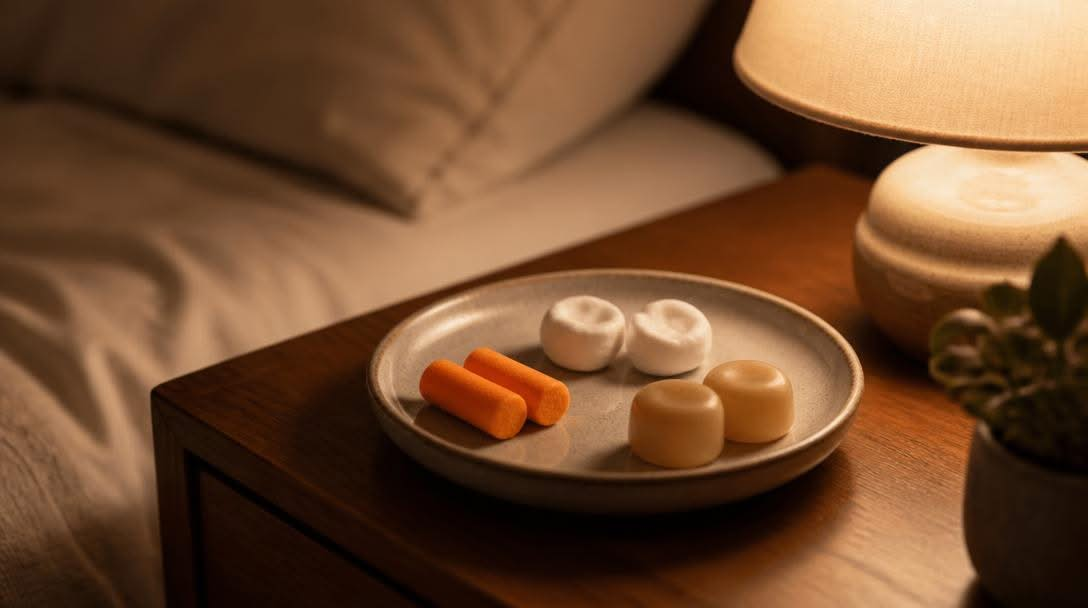
Foam earplugs
Foam is the most common and usually the cheapest option. You roll the plug into a thin cylinder, slide it into the ear canal, and it slowly expands to seal the canal. Because the seal is inside the canal, foam usually blocks the most sound. Disposable foam bought in bulk can cost under 25 cents a pair (Sleep Foundation).
The trade-off is comfort. Some people find expanding foam uncomfortable in a narrow ear canal, and because foam is porous, treat it as disposable.
Silicone putty earplugs
Mouldable silicone works differently. You soften it in your fingers and press it over the opening of the ear canal, like a little cap. It sits at the entrance and goes into the canal very little, if at all. That makes it a favourite for people who hate the feel of foam inside the ear, and it tends to feel flatter against a pillow.
Silicone putty usually blocks a bit less sound than a well-fitted foam plug, and it can pick up hair and lint, so most people replace it after a few nights.
Wax earplugs
Wax plugs are a softer, warmer cousin of silicone putty. Many are made of wax blended with cotton fibres. You warm the plug in your hands, then mould it over the ear opening, where it softens a little more with body heat and seals around the curves of your ear. Many people consider wax among the most effective options for sleep, but it usually costs more and is generally single-use (Sleep Foundation).
The downside is mess. Wax can leave a slight residue, and on a warm night it softens more than you might like.
Reusable silicone and sleep earbuds
Reusable flanged or shaped silicone plugs (like the Loop and Swanwick styles) can be washed and used for months. They cost more up front, often around $10 to $50 a pair, and the fit depends on choosing the right tip size. At the top end, sleep earbuds play masking sounds and can cost well over $100 (Sleep Foundation).
| Type | How it seals | Best for | Watch out for |
|---|---|---|---|
| Foam | Expands inside the ear canal | Maximum blocking, day sleepers, snoring partners | Pressure in narrow canals; disposable |
| Silicone putty | Moulds over the ear opening | Side sleepers, sensitive ears | Blocks a little less; picks up lint |
| Wax | Warms and moulds over the ear opening | Side sleepers who want a soft, snug seal | Can feel messy; single-use |
| Reusable silicone | Shaped tips sit in the outer ear and canal | Nightly users, travel | Higher upfront cost; tip size matters |
What the Noise Reduction Rating (NRR) Really Means
In the US, earplugs are sold with a Noise Reduction Rating, or NRR, printed on the package. It’s measured in decibels, and most earplugs fall somewhere between about 22 and 33 dB (Sleep Foundation). A higher number means more sound blocked in lab conditions.
Three things the box doesn’t tell you:
- Your fit matters more than the number. The NRR is measured with a proper fit. A foam plug that’s only half inserted won’t come close to its rating. A well-seated plug with a lower NRR often beats a badly seated one with a higher NRR.
- Bass gets through. Earplugs are better at blocking higher-pitched sounds than low rumbles. A deep snore, a truck idling or a neighbour’s subwoofer will still leak through some.
- More isn’t always better for sleep. The highest-rated foam plugs press hardest inside the canal. For most bedrooms, comfort first and NRR second is the better rule.
Some brands sold mainly in Europe list an SNR (single number rating) instead of an NRR. The two are tested differently, so don’t compare an SNR on one box directly with an NRR on another.
How to Choose Earplugs for Your Situation
If you sleep on your side
Side sleepers need a plug that doesn’t stick out. Anything that protrudes gets pushed deeper into the ear by the pillow, and that pressure is often what wakes you. Look for low-profile foam that you can push in flush, mouldable silicone or wax that sits flat over the opening, or a reusable plug designed to sit inside the ear’s outer bowl. Your pillow height matters too. If your ear is getting squashed, my guide to the best pillows for side sleepers is worth a look.
If your partner snores
Snoring is low-pitched and irregular, which makes it one of the hardest noises to block. Start with a well-inserted foam plug, since foam usually seals best. If it still gets through, pairing earplugs with a fan or a low, steady sound in the room can help mask what’s left. It’s also worth looking at the snoring itself. Loud, nightly snoring with gasping or pauses in breathing can be a sign of sleep apnea, and that needs a doctor, not an earplug. My post on how to stop snoring covers the warning signs and the fixes that actually work.
If you sleep during the day
Daytime noise is unpredictable: deliveries, construction, doorbells. This is where I’d go for a high-NRR foam plug and pair it with blackout curtains, because light and noise both work against you after a night shift.
If you have small or sensitive ears
Look for small sizes, or switch to mouldable silicone or wax that stays out of the canal. If any earplug causes pain, stop using it.
How to Wear Earplugs Safely
Most people never learn to put foam earplugs in properly, so they get a poor seal and decide the plugs are useless. The CDC’s National Institute for Occupational Safety and Health teaches a simple three-step method for soft foam plugs: roll, pull, hold (NIOSH). It was written for workplace hearing protection, but it works the same at bedtime.
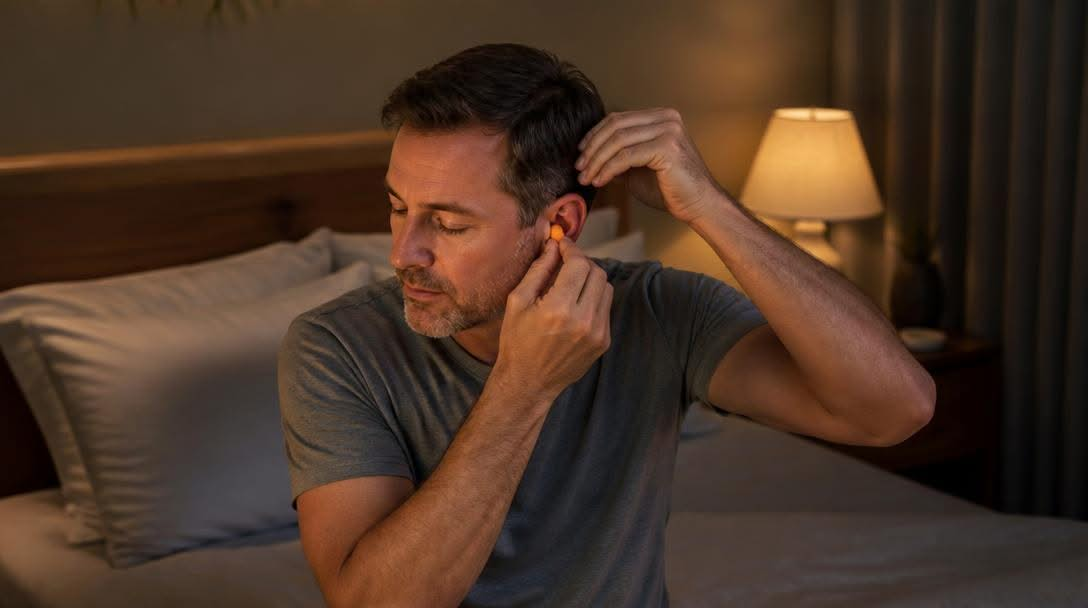
- Start with clean hands. You’re putting something in your ear, so keep dirt and germs out of it.
- Roll. Roll the foam plug between your fingers into a thin, tight cylinder.
- Pull. Reach over your head with the opposite hand and gently pull the top of your ear up and back. That straightens the ear canal.
- Hold. Slide the plug in and hold it in place with a fingertip for 20 to 30 seconds while it expands.
- Check the seal. Sounds should be noticeably muffled and your own voice should sound a bit louder in your head. If not, take it out and try again.
For silicone or wax, warm the plug in your fingers, press it gently over the ear opening, and smooth the edges to seal. Don’t push mouldable plugs into the canal.
To remove any earplug, twist it gently as you pull it out. Pulling straight out fast can be uncomfortable, and the Sleep Foundation notes that inserting a plug too deeply or removing it too quickly could damage the ear canal (Sleep Foundation).
Earwax, irritation and alarms
Earplugs are safe for most adults, but nightly use has a few side effects to watch for:
- Earwax buildup. Cleveland Clinic lists frequent use of earplugs, earbuds and hearing aids as a risk factor for earwax blockage. Signs include ear fullness, muffled hearing, ringing, itching or dizziness. Don’t dig it out with cotton swabs; Cleveland Clinic advises against putting anything in your ear canal, and swabs can push wax deeper (Cleveland Clinic).
- Irritation or infection. Throw foam and putty plugs away after a few uses, wash reusable plugs as the maker recommends, and don’t share them. Ear pain, discharge, a bad smell or fever means stop using them and see a doctor.
- Missing important sounds. Earplugs can make you less likely to hear an alarm, a smoke detector or someone calling for you. Use a vibrating alarm or put your phone where you’ll feel or hear it, and think twice if you’re the one who needs to hear a family member at night.
If you have a history of ear infections, a perforated eardrum, ear tubes or recent ear surgery, check with your doctor before using earplugs every night.
Top Earplug Picks for Sleeping
These picks are based on published specs, materials and the overall pattern of owner reviews, not a hands-on lab test. Noise ratings are the manufacturer’s or retailer’s published figures where I could find them. Ears are personal, so it’s worth buying a cheap variety pack before committing to an expensive pair.
| Pick | Type | Published rating | Best for |
|---|---|---|---|
| Howard Leight MAX | Disposable foam | NRR 33 | Maximum blocking |
| Mack’s Ultra Soft | Disposable foam | See package | Softer foam for sleep |
| Mack’s Pillow Soft | Silicone putty | NRR 22 | Side sleepers, sensitive ears |
| Ohropax Classic | Wax and cotton | SNR (EU rating) | Wax fans, side sleepers |
| Loop Dream | Reusable silicone | About 27 dB | Nightly reusable use |
Howard Leight MAX: best for maximum blocking
The Howard Leight MAX Foam Earplugs are a long-time industrial favourite with a published NRR of 33, at the top of the usual range. The bell shape is designed to stay put once it expands. They’re firm, so they suit people with average-to-larger ear canals who want as much quiet as possible, such as day sleepers.
Mack’s Ultra Soft Foam: best foam for comfort
Mack’s Ultra Soft Foam Earplugs are a softer foam aimed at sleepers. Owners often describe them as gentler than industrial foam, and they come in bulk packs.
Mack’s Pillow Soft Silicone: best for side sleepers who hate foam
Mack’s Pillow Soft Silicone Putty Earplugs mould over the ear opening instead of going into the canal. The published NRR is 22, lower than foam, but they sit flat against a pillow and won’t give you that pressure-inside-the-ear feeling. Good for light noise and for people with small or sensitive ear canals.
Ohropax Classic: best wax option
Ohropax Classic Wax Earplugs are a German wax-and-cotton plug that’s been around for generations. You warm and mould them over the ear opening. Owners who like them tend to really like them, and they’re a common choice for side sleepers. They’re European, so the box lists an SNR rather than a US NRR.
Loop Dream: best reusable pick
Loop Dream Earplugs are a soft reusable silicone plug designed to sit low in the ear for side sleeping. The Sleep Foundation lists them at about 27 dB of noise reduction and picked them as its most comfortable option (Sleep Foundation). They cost more than a box of foam but last for months with cleaning, so the cost evens out if you wear them every night.
When Earplugs Aren’t the Real Fix
Earplugs are great for noise. They don’t fix a sleep problem that isn’t about noise. If you’re blocking every sound and still lying awake for hours, waking up again and again, or feeling exhausted during the day despite a full night in bed, talk to your doctor or a sleep clinic. Chronic insomnia, sleep apnea and other sleep disorders need proper treatment. And if your partner’s snoring is the reason you need earplugs, they may need that conversation too.
Noise is only one part of a good sleep setup. If you want a quick way to check the rest of your bedroom, grab my Free Sleep Checklist. It covers light, temperature, noise and the habits that make the biggest difference.
Frequently Asked Questions
Is it bad to sleep with earplugs every night?
For most adults, no. The main things to watch are earwax buildup, ear irritation and missing alarms. Use clean plugs, replace disposable ones often, and see a doctor if you notice pain, discharge, muffled hearing or ringing that doesn’t go away.
Which earplugs block the most noise?
A well-fitted foam plug usually blocks the most sound, and the highest NRR on most packages is around 33 dB. Fit matters more than the number, so learn the roll, pull, hold method before you blame the plug.
Are silicone or foam earplugs better for side sleepers?
It depends on your ears. Many side sleepers prefer mouldable silicone or wax because it sits flat over the ear opening. Others are fine with a soft foam plug pushed in flush so nothing sticks out.
Can earplugs block snoring completely?
Usually not completely. Snoring is low-pitched and earplugs are weaker against low sounds. A good foam seal plus a fan or steady background sound can bring it down a lot. Loud snoring with gasping or breathing pauses should be checked by a doctor.