Mouth Taping for Sleep: Is It Safe and Does It Work?
Somewhere in the last couple of years, taping your mouth shut before bed went from “weird thing a biohacker said on a podcast” to a full-blown trend. Scroll long enough and you’ll see people promising that a strip of tape over your lips will stop snoring, fix bad breath, sharpen your jawline and give you the deepest sleep of your life.
I get the appeal. When I was working rotating shifts, I would have stuck just about anything to my face if someone promised it would make my four-hour daytime sleeps count for more. Cheap, simple, no prescription. What’s not to like?
Here’s the brutal truth, though: the research behind mouth taping is thin, the benefits that do show up are small and limited to a narrow group of people, and for some sleepers it carries real risk. So let’s go through what mouth taping actually is, what the studies say, who should never try it, and what to do instead if you’re a mouth breather or a snorer.
What Is Mouth Taping?
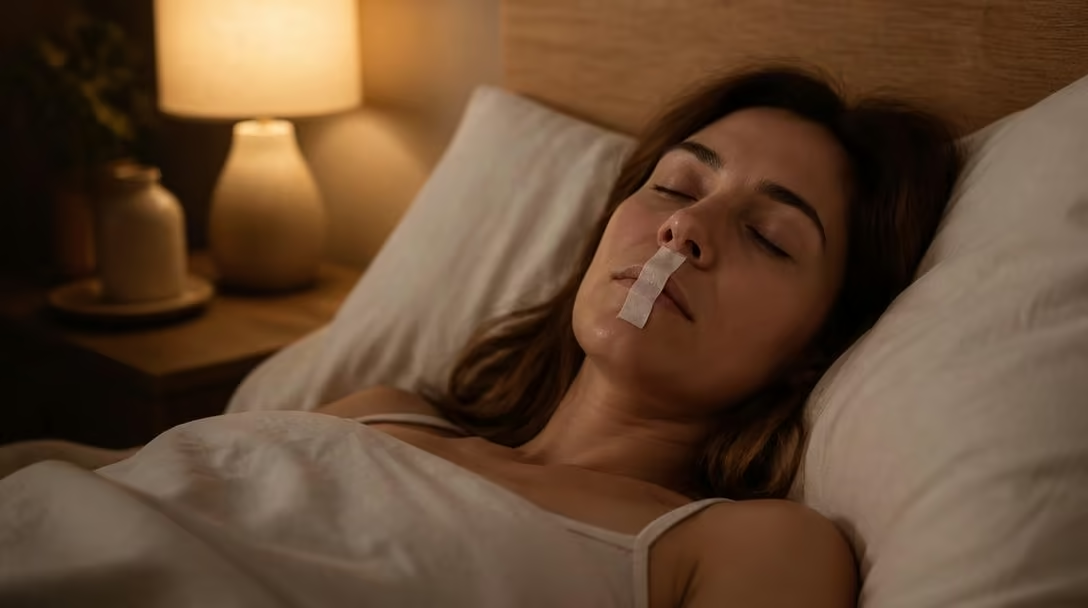
Mouth taping means putting a strip of tape over your lips before you go to sleep so you’re nudged to breathe through your nose all night. People use everything from surgical paper tape to purpose-made “sleep strips” that cover only the middle of the lips or have a small vent in the centre.
The theory is reasonable on its face. Your nose is built for breathing: it warms, humidifies and filters the air, and nasal breathing keeps the jaw and tongue in a more stable position. Breathing through your mouth at night is linked with snoring, dry mouth and a sore throat on waking. So if you could “train” yourself to keep your mouth closed, you might snore less and wake up less parched.
The problem is the jump from “nasal breathing is good” to “taping your mouth shut is good.” Those aren’t the same claim, and the second one is the one that needs proof.
What Mouth Taping Claims to Do
The benefits you’ll see promoted usually include:
- Less snoring
- Fewer breathing pauses in sleep apnea
- Better, deeper sleep and more daytime energy
- Less dry mouth, bad breath and morning sore throat
- Better dental health
- A more defined jawline (yes, really)
According to the Sleep Foundation’s medically reviewed guide to mouth taping, most of these claims are anecdotal, few studies back them up, and there’s no scientific evidence that taping your mouth changes your jawline at all. That last one you can safely cross off the list right now.
Does Mouth Taping Work? What the Research Says
The honest answer is: we don’t really know yet, and what we do know points to “not much, for most people.”
The biggest review so far
In May 2025, a team led by Dr. Brian Rotenberg at Western University in Ontario published a systematic review in PLOS ONE that pulled together every study they could find on mouth taping in people with mouth breathing, sleep-disordered breathing or obstructive sleep apnea. After screening 120 articles from 1999 to 2024, they found just 10 studies with 213 patients in total. That’s a tiny evidence base for a practice millions of people are trying.
Here’s what they found:
- Two studies showed a statistically significant improvement in sleep apnea measures, like the apnea-hypopnea index (AHI) or oxygen drops, in a subset of people with mild sleep apnea.
- The other studies found no meaningful benefit for mouth breathing, sleep-disordered breathing or sleep apnea.
- Several studies raised a potentially serious risk of asphyxiation in people whose noses are significantly blocked, from things like hay fever, chronic rhinitis, a deviated septum, sinus disease or enlarged tonsils.
- Many of the studies excluded people with nasal obstruction to begin with, which means the people most likely to be hurt weren’t even being tested.
The authors’ conclusion was blunt: there is “a potentially serious risk of harm” for people who tape their mouths indiscriminately, and more research is needed before anyone can say it has a clinical benefit. In the press release for the study, the team called it “a contemporary practice that is often celebrity-endorsed, but is not necessarily scientifically accurate.”
The small study people quote
When you see mouth taping defended with real data, it’s usually a 2022 preliminary study in Healthcare. Researchers took 20 mouth breathers with mild obstructive sleep apnea, ran a home sleep test, then repeated it a week later with their mouths sealed with hypoallergenic silicone tape.
The results looked good on paper. The median AHI dropped from 8.3 to 4.7 events per hour, the snoring index fell by about 47%, and 13 of the 20 people (65%) cut their snoring by at least half. People with worse snoring and higher AHI at baseline tended to improve the most.
But look at what that study actually was: 20 people, one night with tape, no control group, all with mild apnea, all screened as mouth breathers. It’s an interesting starting point for researchers. It is not proof that you should tape your mouth tonight, and it says nothing about moderate or severe sleep apnea, people with blocked noses, or long-term use.
The rest of the evidence
Cleveland Clinic sums up the remaining research the same way: small groups, mixed results. One study of 30 people found less snoring with tape. A study of 36 people with asthma found no change in their condition. And in one 2022 study, 10 participants kept trying to breathe through their mouths despite the tape, puffing air out the sides. Cleveland Clinic sleep specialist Dr. Brian Chen put it simply: “There’s not strong enough evidence to support that mouth tape is beneficial.”
| Claim | What the evidence shows | Verdict |
|---|---|---|
| Less snoring | Some improvement in small studies of mouth breathers, mostly with mild apnea | Possible for a few, unproven overall |
| Treats sleep apnea | 2 of 10 studies showed benefit in mild cases only; no evidence for moderate or severe apnea | Not a treatment |
| Better sleep quality | Mostly anecdotal; tape can also cause awakenings and anxiety | Unproven |
| Helps asthma | Study of 36 people with asthma found no meaningful change | No |
| Sharper jawline | No scientific evidence | Myth |
Is Mouth Taping Safe? The Risks
For a healthy adult with a clear nose, a strip of porous tape probably won’t do much harm beyond some irritated skin. The trouble is that a lot of the people drawn to mouth taping are exactly the people it’s riskiest for: heavy snorers, people who wake up gasping, and people who breathe through their mouths because their noses don’t work well.
The risks the Sleep Foundation and Cleveland Clinic list include:
- Trouble breathing if your nose blocks up during the night, from a cold, allergies or just lying down
- Skin irritation, redness or allergic reactions on and around the lips
- Pain removing tape from facial hair
- Anxiety or panic, especially if you’re prone to claustrophobia
- More awakenings and trouble falling or staying asleep
- Danger if you vomit during the night
There’s a quieter risk too, and it’s the one that worries me most. If you’re snoring because of sleep apnea, tape might make the snoring quieter while the breathing problem underneath carries on. Your partner stops nudging you, you feel like you’ve fixed it, and you never get tested. I only found out about my own sleep apnea because my partner noticed I kept stopping breathing at night. If I’d been able to “mute” my snoring with a piece of tape, I might have gone years longer without a diagnosis. I wrote about that whole experience in my guide to sleep apnea.
Who Should Not Tape Their Mouth
This list is long, and it covers a lot of people. Based on the Sleep Foundation, Cleveland Clinic and the 2025 review, don’t try mouth taping if you have:

- Nasal congestion or blockage of any kind: a cold, allergies, hay fever, chronic rhinitis, sinus infections, nasal polyps or a deviated septum
- Enlarged tonsils
- Untreated or suspected obstructive sleep apnea, including loud snoring with gasping, choking or pauses in breathing
- Asthma or COPD, unless your doctor specifically says otherwise
- Heart problems
- Anxiety, panic attacks or claustrophobia
- A risk of vomiting during sleep, for example after drinking alcohol, with reflux or nausea, or when taking medications that cause nausea
Also: never tape a child’s mouth unless a doctor is supervising it. And if you’ve had a few drinks or taken anything sedating, skip it entirely. Alcohol and sedatives make it harder to wake up if something goes wrong.
A quick test: close your mouth and breathe only through your nose for a few minutes while lying down. If that feels hard, stuffy or uncomfortable, your nose is telling you something, and taping won’t fix it. That’s a conversation for your doctor or an ear, nose and throat specialist.
What About Mouth Taping With a CPAP?
This is the one situation where the idea isn’t completely out of left field. If you use a nasal mask or nasal pillows and your mouth falls open at night, air leaks out through your mouth. That can mean dry mouth, a noisy leak and less effective treatment. The Sleep Foundation notes that mouth taping may help reduce those leaks, but that this isn’t established.
I use nasal pillows myself, and on particularly dry nights I use a chinstrap, which is the tool CPAP suppliers have offered for this problem for years. Other options are a full-face mask, a heated humidifier, or adjusting the mask fit. What I wouldn’t do is start taping my mouth under a CPAP mask without talking to my sleep clinic first. They can look at your machine’s leak data and tell you what’s actually going on. If you’re dealing with leaks or noise, my posts on snoring with a CPAP and CPAP pillows go through the common fixes.
If You Still Want to Try It: Safer Ground Rules
Adults with a clear nose, no signs of sleep apnea and none of the conditions above sometimes decide to try it anyway. If that’s you, check with your doctor first, and keep it as low-risk as possible:
- Get checked for sleep apnea first if you snore loudly, wake up gasping or feel exhausted during the day. A home sleep apnea test is often the easiest first step.
- Use tape made for skin, not duct tape, packing tape or anything that seals completely. Gentle, porous, skin-safe tape is the minimum.
- Cover only part of your lips, such as a small vertical strip in the middle, so you can still open your mouth or breathe around it if you need to.
- Practise while awake for 15–20 minutes while reading in bed before you try it overnight.
- Skip it on any night your nose is blocked, you’ve been drinking, or you feel sick.
- Stop if it makes you anxious, wakes you up more, or irritates your skin. A sleep “hack” that makes you sleep worse isn’t a hack.
Safer Ways to Breathe Through Your Nose at Night
If your real goal is less snoring and less mouth breathing, there are better places to start, most of them with more evidence behind them than tape.
Fix your nose first
Most mouth breathing at night starts with a nose that isn’t working well. Treating allergies, a long-running stuffy nose or sinus problems is often the single biggest change you can make. Saline rinses, washing bedding in hot water if you have dust-mite allergies, and keeping pets off the bed can all help. If you’re thinking about decongestants or allergy medications, ask your pharmacist or doctor which one fits you, since some aren’t meant for long-term use and some interact with other medications.
Sleep on your side
Lying on your back lets your jaw and tongue fall backward, which makes both snoring and mouth opening more likely. Side sleeping reduces snoring for people with and without sleep apnea, according to the Sleep Foundation. A supportive pillow helps you stay there; I covered what to look for in pillows for side sleepers.
Try nasal strips or dilators
External nasal strips gently pull your nostrils open and can make nasal breathing easier. The research on them is mixed, and they won’t treat sleep apnea, but they don’t stop you opening your mouth if you need to, which makes them a far lower-risk experiment than tape.
Cut back on alcohol near bedtime
Alcohol relaxes the muscles in your throat and makes snoring worse. Giving yourself a few alcohol-free hours before bed is one of the easiest snoring fixes there is. For more, see my list of 11 ways to stop snoring.
Handle dry mouth directly
If dry mouth is your main complaint, a humidifier in the bedroom, staying hydrated during the day, and good oral hygiene (brushing, flossing, cleaning your tongue) are reasonable first steps. If you use a CPAP, a heated humidifier or a mask change usually helps more than anything you stick to your face.
When to See a Doctor
Mouth breathing and snoring are often symptoms, not the problem itself. Talk to your doctor or a sleep clinic if you:
- Snore loudly most nights, or someone has noticed you stop breathing, gasp or choke in your sleep
- Wake up with headaches, a very dry mouth or a sore throat most mornings
- Feel exhausted during the day even after a full night in bed
- Can’t breathe comfortably through your nose, especially lying down
- Use a CPAP and still snore, leak air or wake up dry
Those are the signs of something a doctor can actually diagnose and treat. Sleep apnea in particular is common, often missed, and very treatable once you know you have it.
If you want a simple way to tighten up the rest of your nightly routine while you sort out the breathing side, grab my Free Sleep Checklist. It’s the list I wish I’d had back in my shift-work days.
Frequently Asked Questions
Is mouth taping safe?
For a healthy adult with a clear nose and no sleep apnea, using a small strip of skin-safe tape is unlikely to be dangerous, but it isn’t proven to help either. For people with a blocked nose, enlarged tonsils, untreated sleep apnea, asthma, COPD, heart problems or anxiety, it can be risky. A 2025 systematic review warned of “a potentially serious risk of harm” when people tape their mouths indiscriminately.
Does mouth taping stop snoring?
It may reduce snoring in some mouth breathers, mostly people with mild sleep apnea, based on a few small studies. It won’t fix snoring caused by a blocked nose or moderate to severe sleep apnea, and it can hide snoring that should be checked by a doctor.
Can mouth taping treat sleep apnea?
No. Only 2 of the 10 studies in the 2025 review showed improvement, and only in mild cases. If you have or suspect sleep apnea, proven treatments like CPAP or an oral appliance are the way to go, and a sleep doctor should guide that decision.
What kind of tape do people use for mouth taping?
People typically use gentle, porous tape designed for skin, or purpose-made mouth strips that only cover part of the lips. Never use duct tape, packing tape or anything that fully seals your mouth. And check with your doctor before trying any of them.
Can I tape my mouth while using a CPAP?
Talk to your sleep clinic first. Mouth leaks with a nasal mask are common, but chinstraps, full-face masks, humidifier changes and mask refits are the usual fixes. Your clinic can check your machine’s leak data and recommend the right one.
Does mouth taping change your jawline?
No. There’s no scientific evidence that mouth taping changes your jawline or face shape.
Sources
- Western University systematic review (2025): Breaking social media fads and uncovering the safety and efficacy of mouth taping in patients with mouth breathing, sleep disordered breathing, or obstructive sleep apnea: A systematic review. PLOS ONE.
- Scimex. Social media fad of nighttime mouth taping may pose serious risks.
- Preliminary study (2022): The Impact of Mouth-Taping in Mouth-Breathers with Mild Obstructive Sleep Apnea: A Preliminary Study. Healthcare.
- Sleep Foundation. Mouth Taping for Sleep.
- Cleveland Clinic. Should You Try Mouth Taping?