Best Sleep Trackers: Rings, Watches and Bedside Devices
For about a decade of rotating shifts, my “sleep tracker” was a mug of coffee and a guess. If I could drive home without the white lines blurring, I figured I’d slept enough. Spoiler: I usually hadn’t. These days you can strap a sensor to your finger, wrist or arm, or slide one under your mattress, and get a sleep score before you’ve even brushed your teeth. The question is which of these gadgets is worth your money, and how much you should trust what it tells you.
This guide covers the main types of sleep trackers, what independent research says about their accuracy, the features that actually matter, and my top picks based on published specs, independent studies and reviewer reports. I’ll also tell you the part the marketing pages leave out: when to put the tracker down and talk to a doctor instead.
Affiliate disclosure: some links in this post are Amazon affiliate links. If you buy through them, Deep Sleep Mastery may earn a small commission at no extra cost to you. I haven’t tested these devices side by side; the picks below are based on manufacturer specs, independent validation studies and published reviews.
What a Sleep Tracker Actually Measures
Here’s the first thing to understand: no consumer sleep tracker reads your brain waves the way a sleep lab does (EEG headbands are the exception, and they’re a niche). A lab sleep study, called polysomnography, uses electrodes on your scalp to see exactly which stage of sleep you’re in. Your ring or watch is making an educated guess from indirect signals:
- Movement. An accelerometer notices when you’re still and when you toss and turn.
- Heart rate and heart rate variability. Your heart slows and its rhythm changes as you move into deeper sleep.
- Breathing rate. Some devices estimate it from your pulse signal or from movement.
- Skin temperature and blood oxygen. Rings and newer watches track overnight trends, which can flag illness or other changes.
The device feeds all that into an algorithm that labels each slice of the night as awake, light, deep or REM sleep. That’s why two trackers worn on the same night can disagree, and why the stage breakdown is the shakiest number on the screen. If you want a refresher on what those stages are, see my posts on REM sleep and how much deep sleep you need.
Types of Sleep Trackers
Sleep trackers come in five main shapes. The right one depends more on what you’ll actually wear (or tolerate) every night than on which has the longest feature list.
| Type | How it measures | Best for | Trade-offs |
|---|---|---|---|
| Smart ring | Pulse, heart rate variability, skin temperature and movement from the finger | People who hate wearing a watch to bed | Pricey; most rings need a membership for full insights |
| Smartwatch | Movement and heart rate from the wrist | People who already want a daytime watch | Short battery life on many models means a charging routine; a bright screen in bed |
| Fitness band or armband | Same sensors as a watch, no (or a tiny) screen | A cheaper, simpler option or a sleep-only device | Less daytime usefulness, or none |
| Under-mattress pad | Pressure changes from breathing, heartbeat and movement through the mattress | People who want nothing on their body | Plugs into the wall; can confuse your partner’s movement or sitting in bed with your sleep |
| Bedside device | Radar or radio signals from the nightstand | Contactless tracking, often paired with an alarm | Usually less detail; needs careful positioning |
A tracker you leave on the charger because it’s uncomfortable is the least accurate tracker of all. Comfort and battery life matter more than people expect.
How Accurate Are Sleep Trackers?
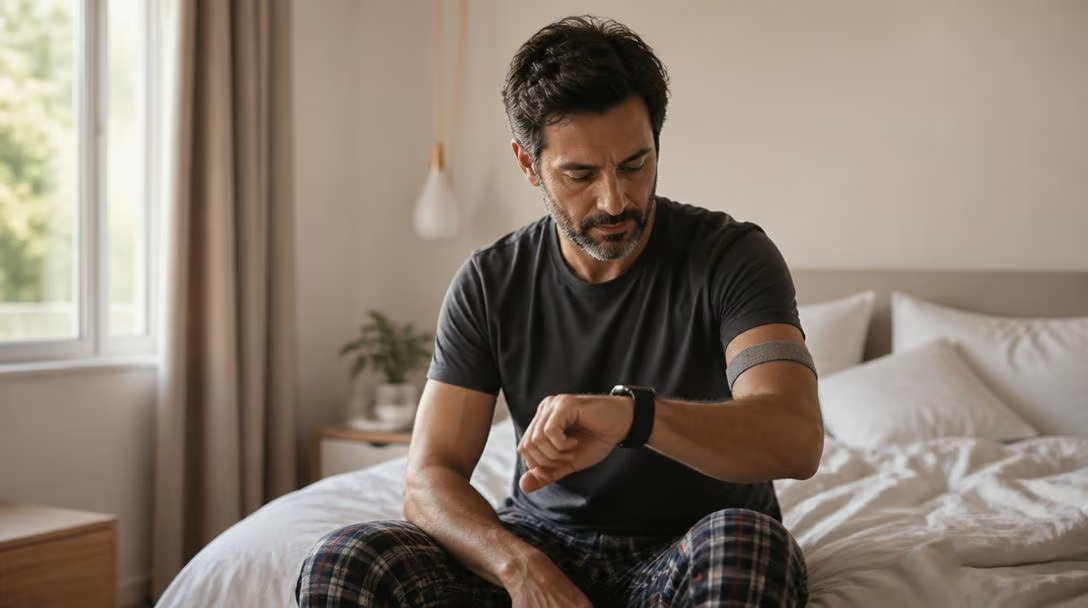
The honest answer: good at telling when you’re asleep, mediocre at telling when you’re awake in the night, and hit-and-miss on sleep stages. Three pieces of research are worth knowing.
A six-device hospital study (2025)
Researchers at Antwerp University Hospital had 62 adults, including people being checked for sleep apnea, wear two to four wrist devices during a night of in-lab polysomnography. They tested the Fitbit Charge 5, Fitbit Sense, Withings ScanWatch, Garmin Vivosmart 4, Whoop 4.0 and Apple Watch Series 8 (Schyvens et al., SLEEP Advances, 2025). The findings line up with what sleep doctors have said for years:
- Every device caught sleep well: sensitivity ran from about 92% to 96%.
- Every device struggled to spot wakefulness: specificity was only about 29% to 52%, and all six underestimated time awake after falling asleep, by roughly 12 to 48 minutes.
- Agreement on sleep stages was moderate at best. The Apple Watch scored highest (kappa 0.53), followed by the two Fitbits (0.41–0.42); the Garmin and Withings scored lowest (0.21–0.22).
- Several devices overestimated deep sleep (the Garmin by about 44 minutes, the Whoop by about 31), while the Apple Watch underestimated it by about 25.
The authors concluded that all the devices need work on stage tracking, and that the better-scoring ones may be useful for tracking large, sustained changes. Note that these were older models, the sample was mostly men, and each person was recorded for a single night.
A ring-vs-watch study (2024)
A smaller study of 35 healthy adults compared the Oura Ring Gen 3, Apple Watch Series 8 and Fitbit Sense 2 against polysomnography (Robbins et al., Sensors, 2024). All three caught at least 95% of sleep. For four-stage agreement, the Oura scored highest (kappa 0.65), then Apple (0.60) and Fitbit (0.55). Two big caveats: Oura funded the study, and it was one night per person. I go deeper into this one in my Oura Ring vs Apple Watch comparison.
The big picture
A 2025 meta-analysis in the Journal of Clinical Sleep Medicine pooled 24 studies with 798 participants and concluded that wrist-worn trackers are not as reliable as polysomnography (Lee et al., 2025). The American Academy of Sleep Medicine’s position is that consumer sleep technology can’t be used to diagnose or treat sleep disorders, though it may help your conversations with a clinician (AASM position statement).
So the smart way to use any tracker is for trends, not verdicts. If your average total sleep has dropped by 45 minutes over a month, that’s real information. If last night’s deep sleep was “only 52 minutes,” that number could easily be off by half an hour either way.
What to Look for in a Sleep Tracker
Comfort you’ll tolerate every night
Side sleepers often find watches dig in; some people can’t stand anything on their finger. If you’ve never worn something to bed, a ring or a soft band is usually the easiest start. If you want nothing on your body at all, look at an under-mattress pad.
Battery life that fits your routine
A watch that needs charging every day has to be charged at a time you’re not wearing it, which for many people means the shower or the morning commute. Rings and screenless bands often last close to a week. Under-mattress pads plug into the wall, so battery is a non-issue.
The real price, including membership
Several popular trackers lock their best features behind a monthly or yearly membership. Add up two or three years of fees before you compare sticker prices.
Your phone
The Apple Watch needs an iPhone. Most rings and bands work with both iPhone and Android, but check before you buy.
Features that change behavior
Numbers alone don’t fix sleep. Look for features you’ll act on: a consistent bedtime reminder, a gentle vibrating alarm instead of a blaring one, and weekly trends rather than daily grades. If waking up is your biggest problem, a sunrise alarm clock might help more than another score.
Health alerts (with realistic expectations)
Some devices now watch for breathing disturbances or flag possible sleep apnea. These can be a useful nudge to get checked, but a quiet app doesn’t mean you’re in the clear, and an alert isn’t a diagnosis. Only a proper sleep test can tell you that; my guide to home sleep apnea tests explains how that works.
Top Sleep Tracker Picks for 2026
These picks are based on published specs, independent research where it exists, and reviewer reports (including Tom’s Guide’s tested roundup, updated October 2026). Prices are US list prices at the time of writing and change often.
| Pick | Type | Price (US) | Membership |
|---|---|---|---|
| Oura Ring 5 | Smart ring | From $399 | $5.99/month or $69.99/year |
| Apple Watch Series 11 | Smartwatch | From $399 | None (needs an iPhone) |
| Garmin Index Sleep Monitor | Upper-arm band | $169.99 | None for core features |
| Whoop MG | Screenless strap | Included with Life membership ($359/year) | Required |
| Fitbit Air | Screenless wristband | $99 | None for core tracking |
| Withings Sleep Analyzer | Under-mattress pad | $169.95 | None listed |
Best ring: Oura Ring 5
Oura’s newest ring launched in mid-2026 and is about 40% smaller than earlier versions, with 6 to 9 days of battery depending on size. It tracks sleep stages, heart rate variability, skin temperature and a suggested sleep window, and adds new overnight features that flag breathing disturbances and blood pressure patterns worth discussing with a doctor (rolling out in select countries first). Earlier Oura models have some of the stronger validation data among consumer devices, though much of it is company-funded. The catch: you need a $5.99/month membership for most insights.
Best watch: Apple Watch Series 11
If you want one device for the whole day, the Apple Watch is the obvious choice for iPhone users. It now gives a nightly Sleep Score and can send sleep apnea notifications based on breathing disturbances. In the 2025 hospital study, an older Apple Watch had the best stage agreement of the six wrist devices, though it underestimated deep sleep. The downsides are daily-ish charging and a screen on your wrist in bed.
Best sleep-only wearable: Garmin Index Sleep Monitor
This is a soft, screenless band you wear on your upper arm only at night, which is great for anyone who dislikes things on their wrists or fingers. It tracks sleep stages, heart rate variability, breathing rate, blood oxygen and skin temperature, has a vibrating smart alarm, and lasts about a week per charge with no fee for the core features. It doesn’t do daytime tracking.
Best for recovery data: Whoop MG
Whoop is built around strain, recovery and “sleep debt”, which suits athletes and data lovers. Battery life is long and there’s no screen. You don’t really buy the hardware; you buy a yearly membership, and the MG comes with the higher Life tier ($359/year). An older Whoop overestimated deep sleep by about half an hour in the 2025 study, so treat its stage numbers as rough.
Best budget pick: Fitbit Air
Google’s screenless Fitbit Air costs $99, works with iPhone and Android, lasts up to about a week, and gives you a sleep score, sleep goals and a vibrating alarm. Some people find it bulky overnight. If you want to find out whether tracking helps you at all before spending $400, start here.
Best contactless option: Withings Sleep Analyzer

This thin pad slides under your mattress and plugs into the wall, so there’s nothing to wear and nothing to charge. It tracks sleep duration, stages, heart rate, breathing rate and snoring, and Withings markets it for flagging breathing disturbances. A related prescription version, Withings Sleep Rx, received FDA clearance in 2024 as a home sleep apnea test, but that version goes through a doctor. Reviewers note it can mistake sitting up in bed for naps.
Prefer something you wear on your head? My post on the Bluetooth sleep headband covers that category.
How to Use a Sleep Tracker Without Wrecking Your Sleep
There’s a name for getting so fixated on sleep data that it makes your sleep worse: orthosomnia (Sleep Foundation). I get it. When I was running on fumes between shifts, a red “poor sleep” badge first thing in the morning would have been the last thing I needed. A few rules help:
- Judge by how you feel first. If you wake rested and stay alert all day, a mediocre score doesn’t matter.
- Look at weekly averages. Ignore single nights, especially stage numbers.
- Test one change at a time. Move your bedtime earlier, skip late caffeine or cut evening alcohol for two weeks, then compare trends.
- Don’t check the app in the middle of the night. Turn off non-essential notifications and keep the screen dark.
- Take breaks. If tracking is making you anxious, put the device in a drawer for a week.
Want a simple, screen-free place to start? Grab my Free Sleep Checklist and work through the basics before you obsess over a score.
When to See a Doctor Instead
A tracker is a mirror, not a medical test. See a doctor or sleep clinic if you notice any of these, whatever your device says:
- Loud snoring, gasping or choking at night, or a partner who notices pauses in your breathing (see what sleep apnea is)
- Heavy daytime sleepiness, or nodding off while reading, watching TV or driving
- Trouble falling or staying asleep at least three nights a week for months
- Your device repeatedly flags breathing disturbances or low overnight oxygen
- Low mood or anxiety that’s tied up with your sleep
Bring your tracker’s trends to the appointment. The AASM notes that this kind of data can help the conversation, even though it can’t make a diagnosis.
Frequently Asked Questions
What is the most accurate sleep tracker?
No consumer tracker matches a sleep lab. In independent studies, recent Oura rings and Apple Watches have tended to score among the better devices for sleep stages, but results vary by study, by model and by who funded the research. All of them are much better at detecting sleep than at detecting time awake during the night.
Is a sleep ring better than a watch?
For sleep alone, many people find a ring more comfortable and less disruptive, and the battery lasts longer. A watch makes more sense if you want daytime features like notifications and workout tracking. Accuracy differences between good rings and good watches are smaller than the comfort difference.
Can a sleep tracker detect sleep apnea?
Some devices can flag patterns that suggest sleep apnea, and that’s a good reason to get checked. But they can miss it, and an alert isn’t a diagnosis. A home sleep apnea test or an in-lab study, ordered by a doctor, is how sleep apnea is diagnosed.
Do I need a subscription for a sleep tracker?
Not always. Oura and Whoop need memberships for full features. The Apple Watch, Garmin Index Sleep Monitor and Fitbit Air give you core sleep tracking without a fee. Check the current terms before you buy, since companies change them.
Can a sleep tracker improve my sleep?
Only if it changes what you do. Used for trends, it can help you see the effect of a regular bedtime, less late caffeine or less evening alcohol. Used as a nightly grade, it can make sleep worse. If you’re short on sleep, the fix is still mostly habits; see whether 6 hours of sleep is enough for you.
The Bottom Line
The best sleep tracker is the one you’ll wear every night and read calmly once a week. For most people that’s a ring (Oura) or the watch they already want (Apple Watch). If you want sleep-only tracking without a fee, look at the Garmin armband or the Withings pad, and if you just want to try tracking, the $99 Fitbit Air is a low-risk start. Whatever you pick, trust the trends, not the nightly stage breakdown, and let a doctor, not an app, decide whether something’s wrong.
Sources
- Schyvens A-M, et al. Six commercial wrist-worn sleep trackers compared with polysomnography (study summary). SLEEP Advances, 2025.
- Robbins R, et al. Accuracy of Three Commercial Wearable Devices for Sleep Tracking in Healthy Adults. Sensors, 2024.
- Lee et al. Performance of consumer wrist-worn sleep tracking devices compared to polysomnography: a meta-analysis. Journal of Clinical Sleep Medicine, 2025.
- American Academy of Sleep Medicine. Consumer Sleep Technology: An AASM Position Statement.
- Sleep Foundation. Orthosomnia.


