SAD Lamps for Better Sleep and Darker Winter Mornings
Every year around mid-October, the same thing happens. The alarm goes off, the window is still black, and my body flatly refuses to believe it’s morning. When I was working rotating shifts, the dark months were always the hardest stretch of the year: waking in the dark, driving home in the dark, and feeling like my internal clock had lost the plot entirely.
That’s the problem a SAD lamp is built to solve. These bright light boxes were designed to treat seasonal affective disorder (SAD), the winter-pattern depression that shows up as the days get shorter. Because light is the main signal that sets your body clock, they’re also used for something more everyday: waking up properly on dark mornings and keeping your sleep schedule from drifting later all winter.
Here’s what a SAD lamp actually does, what the research says, how to use one without wrecking your sleep, what to look for when you buy, and a few top picks based on published specs and independent testing.
Affiliate disclosure: some links in this post are Amazon affiliate links. If you buy through them, Deep Sleep Mastery may earn a small commission at no extra cost to you. I haven’t personally tested the lamps below; the picks are based on published specifications, independent lab measurements where available, and the overall pattern of expert and owner reviews.
What Is a SAD Lamp?
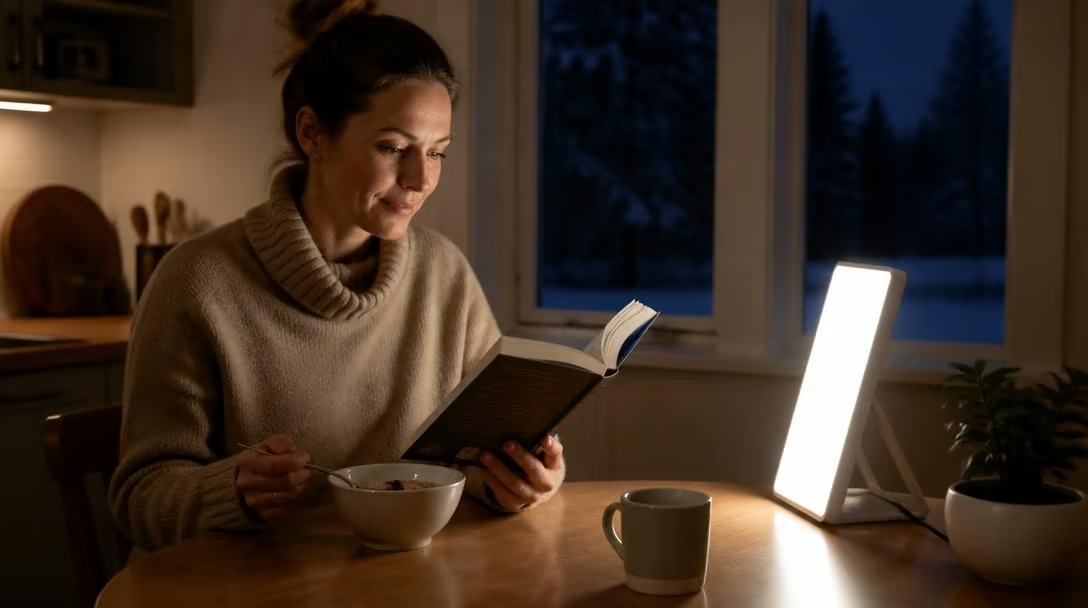
A SAD lamp (also called a light box or light therapy lamp) is a panel that gives off very bright, diffuse white light, much brighter than normal indoor lighting, while filtering out most ultraviolet (UV) light. You sit near it for a set time each morning with your eyes open, doing something else: eating breakfast, reading, answering email. You don’t stare into it.
The standard clinical dose you’ll see everywhere is 10,000 lux. Lux is a measure of how much light actually reaches your eyes, and it drops off fast as you move away from the source. That detail matters a lot when you shop, and it’s where a lot of cheap lamps get slippery. More on that below.
A SAD lamp is not the same thing as a sunrise alarm clock. A sunrise alarm clock slowly brightens your bedroom before you wake up, usually to a few hundred lux at most. A SAD lamp is a much brighter dose you use once you’re up. Some people use both: the wake-up light gets you out of bed, and the light box sets your clock once you’re sitting at the table.
How Bright Light Affects Your Sleep
Your sleep-wake cycle runs on a roughly 24-hour internal clock, and light is the strongest cue that keeps it in sync. Morning light tells your brain the day has started, shuts down melatonin and sets the timer for when you’ll feel sleepy that night. In winter, many of us get a weak, late signal: dim indoor light all day and bright screens at night, so the clock drifts later. The Sleep Foundation’s guide to light therapy describes it as a way to realign your circadian rhythm “with the patterns of the sun.”
That’s why light therapy is used for more than SAD. The Sleep Foundation lists circadian rhythm problems (including extreme night owls and shift workers), jet lag and some types of insomnia as uses alongside seasonal depression, with timing adjusted to the problem. For most people whose clock runs late, morning light is the one that helps.
Do SAD Lamps Actually Work?
For winter-pattern SAD, light therapy is one of the main recommended treatments. The National Institute of Mental Health describes it as typically involving a very bright 10,000-lux light box, used for 30 to 45 minutes a day, usually in the morning, from fall through spring.
The research behind that is real but not perfect, and I’d rather you hear both halves:
- A frequently cited 2005 meta-analysis in the American Journal of Psychiatry found that bright light treatment and dawn simulation both significantly reduced symptoms in SAD. The same authors also pointed out that many light therapy studies weren’t rigorously designed, and only a small share of the studies they reviewed met their criteria.
- A 2020 meta-analysis of 19 randomized trials in Psychotherapy and Psychosomatics found that bright light therapy beat dim-light or sham placebo for SAD, but the effect was more modest, and the authors flagged moderate-to-high risk of bias and called for larger, better trials.
So the honest summary: light therapy has solid support as a SAD treatment, and it’s a reasonable, low-risk thing to try for winter morning grogginess and a drifting sleep schedule. It isn’t magic, and the effect for people without SAD hasn’t been studied as heavily. The NIMH also notes that a version of talk therapy adapted for SAD (CBT-SAD) worked about as well as light therapy in a head-to-head comparison, with benefits that appeared to last longer.
One important line: if your winter slump involves low mood most days, losing interest in things you used to enjoy, or feeling hopeless, that’s not something to self-treat with a gadget from Amazon. Talk to your doctor. SAD is a form of depression, and it’s very treatable with proper support. If you’re ever having thoughts of suicide, call or text 988 in the US.
How to Use a SAD Lamp for Better Sleep

Owning the lamp is the easy part. Here’s the routine most sources agree on.
1. Use it within the first hour of waking
Mayo Clinic’s guidance is to use the light box within the first hour after you wake up. Morning light is what nudges a late-running clock earlier. Bright light in the evening can push your clock the other way, unless your doctor has told you to use it then (some shift workers are given evening light on purpose).
2. Start with 20 to 30 minutes
Mayo Clinic suggests about 20 to 30 minutes at 10,000 lux; the NIMH cites 30 to 45 minutes. Brightness and time trade off: a dimmer light needs a longer session. The Yale Winter Depression Research Clinic explains that 30 minutes at 10,000 lux is roughly the same dose as 60 minutes at 5,000 lux or 120 minutes at 2,500 lux. Start at the shorter end.
3. Sit at the distance the manufacturer specifies
Mayo Clinic’s typical range is about 16 to 24 inches from your face, but this depends entirely on the lamp. Every lamp only reaches its rated lux at a specific distance. Sit farther back and you’re getting a fraction of the dose.
4. Eyes open, but don’t stare
Keep your eyes open, but angle the lamp off to one side or slightly above your line of sight and get on with breakfast or reading.
5. Be consistent, and give it time
Benefits usually show up over a few days to a few weeks, not after one session. Use it at roughly the same time every morning, including weekends. That consistency is the whole point: you’re giving your body clock the same strong signal at the same time every day. If your schedule has already drifted, pair the lamp with my step-by-step plan for fixing your sleep schedule.
6. Start early in the season
The NIMH describes light therapy as running from fall through spring, so if the dark months hit you hard every year, don’t wait until January to start. The clock change makes this even more relevant: when the US falls back on November 1, mornings get lighter for a few weeks, but evenings go dark early. My guide to daylight saving time and sleep walks through how to handle that week.
Side Effects and Who Should Be Careful
For most people, light boxes are low-risk. The Sleep Foundation lists eye strain, headache, nausea, feeling wired or jittery, and skin irritation as possible side effects, which often settle after a few days or with a shorter session or more distance.
Check with your doctor before you start if any of these apply to you:
- Bipolar disorder. Mayo Clinic warns that increasing light exposure too quickly, or using a light box too long, may trigger manic symptoms in people with bipolar disorder.
- Eye conditions. Glaucoma, cataracts, macular degeneration or diabetes-related eye damage: get advice from your eye doctor first.
- Light-sensitizing medications. Some medications and supplements make your eyes or skin more sensitive to light. The NIMH specifically mentions this, so check with your doctor or pharmacist.
- Depression symptoms. If your mood is low, a light box can be part of treatment, but it should be alongside a doctor, not instead of one.
Also note that light boxes are not FDA-approved or regulated for SAD, according to Mayo Clinic, so quality and claims vary widely between brands. That’s the main reason the next section exists.
What to Look For in a SAD Lamp
The single most useful resource I found is the Yale Winter Depression Research Clinic’s guide to choosing a light box, which includes their own lux measurements of several devices. Their biggest warning: lots of lamps are sold as “10,000 lux” without saying at what distance, and they cite one device that only reaches 10,000 lux at 6 inches from your face. Nobody eats breakfast with a lamp 6 inches from their nose.
| Feature | What to look for | Why it matters |
|---|---|---|
| Brightness + distance | 10,000 lux at a stated distance (ideally 12 in or more) | “10,000 lux” with no distance is meaningless |
| UV filtering | Made for SAD/mood, filters most or all UV | Lamps for skin conditions emit UV that can harm eyes |
| Panel size | Larger panel | Lets you sit farther back and move a little |
| Light color | Broad white light | Yale doesn’t recommend blue-light devices |
| Stand and angle | Adjustable, sits above or beside eye line | Comfortable to use daily without staring at it |
A few more points:
- Bigger is easier. A larger panel lets you sit farther back and move your head a little without losing the dose. Small, cheap panels force you to sit close and stay put.
- White, not blue. Yale does not currently recommend blue-light treatment devices, noting blue light is the most damaging to the retina. Stick with a broad white light box.
- Look for a return window. Yale suggests giving it about four weeks to judge whether it’s working, so a decent trial or return period is worth having.
- Measure it yourself. Yale reports that free lux-meter phone apps are reasonably accurate. Hold the phone where your face will be and check the reading.
Top SAD Lamp Picks
These picks are based on published specs and, where available, Yale’s independent measurements and independent review testing. I haven’t tested them myself. Prices and availability change, so check the listing before you buy.
| Lamp | Best for | Rated / measured output | Size |
|---|---|---|---|
| Carex Day-Light Classic Plus | Best all-round | 10,000 lux at ~13 in (Yale listing) | ~13 × 15 in, on a stand |
| NorthStar 10,000 | Sitting farther back | 10,000 lux at 24 in (maker); Yale’s tests close | ~21.5 × 11 in |
| BOXelite OS | Mid-size desk box | ~7,000 lux at ~16 in (Yale measured) | ~15 × 12 in |
| Verilux HappyLight Lucent | Budget / trying it out | Up to 10,000 lux at ~6 in | ~8.6 × 6.6 in |
Carex Day-Light Classic Plus: best all-round light box
This is the classic “real” light box: a large panel on an adjustable stand that projects light down toward you, much like natural overhead daylight. Yale lists it at about 13 by 15 inches and rated at 10,000 lux at 13 inches, and Wareable’s review lists it at up to 10,000 lux at 12 to 14 inches. It’s bulky and pricier than the little panels, but the size is exactly what makes it easier to get a proper dose.
Check the Carex Day-Light Classic Plus on Amazon
NorthStar 10,000: best if you want to sit farther back
One of Yale’s preferred large boxes. It’s about 21.5 by 11 inches and rated by the manufacturer at 10,000 lux at 24 inches, and Yale’s own measurements came close to that. That distance is the big selling point: you can sit at a normal table with the box out of the way and still get the full dose.
Check the NorthStar 10,000 on Amazon
Northern Light Technologies BOXelite OS: mid-size desk option
A mid-size box (about 15 by 12 inches) with legs, now sold as the BOXelite OS. Yale measured it at about 7,000 lux at roughly 16 inches, which meets their minimum but means you’ll want a somewhat longer session or to sit a bit closer than with the bigger boxes. A sensible middle ground if a full-size panel won’t fit your space.
Check the BOXelite OS on Amazon
Verilux HappyLight Lucent: budget pick, with a catch
Small, light, simple and inexpensive, with a stand that also wall-mounts. Wareable named it its pick for simplicity. The catch is the one Yale warns about: it’s rated at up to 10,000 lux at about 6 inches. At a comfortable 16 to 20 inches you’ll get far less, so plan on longer sessions or sit closer. It’s a reasonable way to try light therapy cheaply, as long as you go in with realistic expectations.
Check the Verilux HappyLight Lucent on Amazon
Other Ways to Get More Morning Light This Winter

A light box works best as part of a broader winter routine, not as a stand-alone fix. These help too, and most of them are free:
- Get outside early. Even an overcast winter morning outdoors is usually much brighter than indoor lighting. A 15-minute walk after sunrise counts.
- Keep your wake time fixed. Same time every day, weekends included. This matters more than your bedtime.
- Dim the evenings. Lower the lights and put screens away for the last hour before bed so the morning signal isn’t fighting a bright evening one.
- Keep the bedroom cool and dark. Heating cranks up in winter, but a cooler room still helps you stay asleep. See do you sleep better in the cold for why.
If you want all of this as a simple routine to stick on the fridge, grab my free sleep checklist. It covers the daily habits that matter most.
FAQ
Can a SAD lamp help with sleep even if I don’t have SAD?
Possibly. Morning bright light helps anchor your body clock, which is why the Sleep Foundation lists circadian rhythm problems and some insomnia among light therapy’s uses. Most of the strong research is in SAD, though, so think of it as a reasonable thing to try for winter grogginess and a late-drifting schedule, not a guaranteed fix.
Can I use a SAD lamp at night?
Generally, no. Bright light in the evening can push your body clock later and make it harder to fall asleep. Use it within the first hour after waking, unless a doctor has specifically told you to use evening light (for example, for some night-shift schedules).
How long does it take for a SAD lamp to work?
Usually a few days to a few weeks of daily use. Yale suggests about four weeks is enough to judge whether it’s helping you.
When should I see a doctor?
If your winter slump includes persistent low mood, losing interest in things, big changes in sleep or appetite, or trouble functioning, see your doctor. SAD is a form of depression and responds well to treatment, which may include light therapy, talk therapy or medication.
The Bottom Line
A SAD lamp is one of the few sleep gadgets with real evidence behind it, at least for seasonal affective disorder, and a low-risk tool for anyone who struggles with dark winter mornings. Buy one that delivers its rated brightness at a distance you’ll actually sit at, use it in the first hour after waking, and do it every day. If winter is hitting your mood and not just your mornings, bring your doctor into it.